Improve Google Ranking - How to Improve Your Ranking
Update January 2024:
Key Points to Improve Your Google Ranking
Discover effective methods to boost your Google ranking, drive more traffic, and generate revenue. We cover both on-page and off-page optimization techniques.
On-Page Optimization
- Meta Tags: Optimize title and description tags for clear and appealing display in search results.
- Headlines: Incorporate primary keywords into concise and engaging headlines.
- Content: Create meaningful, well-structured, and naturally worded content that includes the primary keyword frequently.
Off-Page Optimization
- Backlinks: Build high-quality backlinks to improve your ranking.
- Social Media Marketing: Utilize social media to increase awareness of your website and enhance engagement.
Advanced Optimization Tips
- Keywords: Select relevant keywords and naturally integrate them into your content.
- Load Time: Optimize your website's load times.
- Internal Linking: Link relevant pages within your website.
- Regular Updates: Keep your content updated regularly.
- Mobile Optimization: Ensure your website performs well on mobile devices.
- Local SEO: Optimize your website for local search queries.
Use these strategies to consistently improve your Google ranking and achieve a top position in search results.
Strategies for Top Position in Google
80% of people searching on the Google search engine click on a top-ranking result. This refers to the top position or even the first place. Statistics show that clicks occur within the offerings on page 1. In special cases, people may search on page 2 or 3, but usually never beyond. Learn more about the most important ranking factors and how to dominate them in this comprehensive article about ranking factors and their application.
Instantly Improve Ranking - Here's How
The most important metrics to instantly optimize your ranking in Google - and all the significant updates regarding the Google Page Experience Update for mobile. This also includes the March 2022 updates for desktop.
The big SEO Update 2021 - BIEG Hessen Web Seminar
Short-Cut to Success: Attend one of the many free Site Clinics with Ralf Seybold
Free Offers for Website Analysis
SiteClinic: Examples and Dates
Find out how to get to the top of Google and what you need to improve on your website:
SEMrush SiteClinic - live every second Thursday
Feel free to sign up for my regular SiteClinics with Semrush. Maybe we'll chat live on YouTube next Thursday?
Archive of all previous SiteClinics with Semrush and Link Research Tools
If you want to learn more about my SiteClinics, you can find them easily on Youtube:

Initial Consultation with SEO Agency
Every SEO agency offers an initial website analysis. However, the costs for this service vary greatly. There are free offers that are essentially worthless, as they only provide a basic analysis from a cheap tool. On the other hand, there are initial analyses that can cost up to €2,500.
At SEYBOLD, we provide a free initial analysis covering the entire scope of optimization possibilities. Feel free to request one and make use of our contact options. The first analysis provides the best planning security for your SEO budget and initial points for improvement.
Depending on the complexity of your website, it may be necessary to conduct a comprehensive audit. Typically, the information obtained from such audits is much more in-depth and provides answers to specific questions.
What Factors Can Improve Google Ranking?
The most crucial factors contributing to a higher ranking in Google include the content of the website (comprehensive texts, well-named images, etc.), backlinks (topic-relevant links from other websites), the snippet (title and description), and the technical structure of the page.

Achieve Google Top Position and Permanently Improve Google Ranking - with these tips, you'll reach position 1 - for websites and online shops.
Approximately half of all clicks are generated through the top positions (position 1 to position 3). Finding a strategy to increase visibility and be more discoverable in the search engine, of course, doesn't apply exclusively to Google. The best approach is a concept that extends across digital channels, considering the key areas of business activity.
You're on this page because you know that I've been involved in internet marketing since 1998 and have written for publications such as the SEMrush Blog, ahrefs Blog, and even for Springer Gabler Verlag. From my work with small and medium-sized enterprises, it's clear to me that this clientele often doesn't have unlimited budgets, a significant disadvantage. Since 1998, I've advised hundreds of clients and implemented joint strategies. We have over 3500 active newsletter subscribers and 3000 Twitter followers for the regular release of SICHTBAR SEYBOLD. Our eBook was the number 1 management eBook on Amazon in October 2014. Numerous users follow my tips for SMEs and small businesses on Twitter.
This article explains the necessary steps to achieve good positions in Google. I'll show you the most important ranking factors and basics with which you can step by step (so to speak, as an SEO checklist or SEO tips) land at the top.
Once you've finished reading the article, you'll know the basics to bring your site to the forefront.
How do I get to page 1 on Google?
For the first page on Google, the following topics are crucial:
- Technical SEO: A clean, technically flawless website.
- Content: Content that is well-structured and provides relevant added value for the visitor.
- Backlinks: Clean, non-purchased backlinks that support the site's relevance.
If you master these, then you "only" need good user behavior on the site to achieve a position on the first page.

SEYBOLD is a certified Google Partner
How to check if your own site is already in the Google index?
If you search for your site and can't find it, you should first check if your site is even present in the Google index. To do this, go to Google's search view and enter 'site:domain' in the search bar (replace 'domain' with your domain, for example, seybold.de, or with a specific page. You can find an example here). If the page is present, you can now think about how to improve the ranking - ideally, achieve a top position (e.g., position 1 in Google).
If the page is not in the Google index, then you should investigate why. Usually, this is due to crawling errors or indexing errors. You can find all the information you need in the Google Search Console (here's a help page from Google on this topic). If everything 'seems' fine, it could also be due to a negative SEO attack that the page is not found. In any case, you should consult a specialist who can analyze this accordingly.
Is being in position 1 on Google the right strategy?
In the past, it was the task of webmasters to get a website to position 1 on Google (in organic search results). Nowadays, this goal varies - especially because achieving it easily is no longer possible. With the advanced instrumentalization of the search engine by Alphabet, even poorly placed results can get good clicks that lead to conversion.
Methods like microdata (Schema.org, Google Data Highlighter) can bring additional results on the search page. Especially in search results, the Knowledge Graph is increasingly prominent, providing a user with enough information that they no longer need to leave the search results page or even visit position 1.

The Google Knowledge Graph allows for quick searchers to receive instant information. For SEO and SEA, this means a decrease in traffic because users don't have to leave the Google search engine.
The same applies to searches for sports results, hotels, flights, weather, and so on. The increased use of microdata makes optimization for informational sites increasingly difficult unless you are the brand owner.
Local results, such as retailers, can benefit greatly from an optimized Local SEO strategy because when searching on Google, not only the keyword but also the location from which the search is made is taken into account. Regardless of the user's intention, the approximate location can be determined based on the IP address, and then the appropriate search result is presented.
Increasingly, what becomes more interesting for the visitor is not just the traffic, i.e., who comes to the site, but also how they can become a customer there, which is why the strategy of ranking 1st on Google takes a back seat in favor of visibility management.
The Role of Visibility Management
Visibility means that a company's offers and services are present and perceived through the most important channels. This applies to advertising on vehicles, as well as company brochures, websites, Google ads, Facebook ads, and communication with customers via newsletters, Twitter, and other channels. Bundling this is a much more complex task and today, much more important than achieving position 1 in Google search results.

Changing Needs
Recurring customers, retention through good performance, and visualizing potential customers are the magic words of the current era. Thus, the need to achieve position 1 in Google changes in favor of a top placement and an optimized, holistic marketing concept.
Nevertheless, corresponding rules apply, which are described further below.
First, let's take a look at the world of obscure offers:
Promises and Guarantees for Position 1 and Other Urban Legends
On the internet and in your email inbox, you'll find daily offers promising and guaranteeing position 1 in Google. The cheapest variant I encountered was a top placement for a one-time fee of €49.00. Such offers are scams or black-hat SEO tactics that can result in a permanent ban from search result listings.
The annual costs for SEO measures are at least four figures. Those who lure with cheap offers cannot deliver serious work. The tasks aimed at optimization become more difficult each year. And Google's guidelines and algorithm updates add to the challenge.

Are these SEO offers reputable?
Advertised strategies are often concepts from a "bygone era." Due to multiple daily updates of the search engine algorithm and changing values in optimization measures, such offers are often outdated. Nevertheless, the number of such offers is increasing. The fact that a company invests a lot of money in AdWords speaks for itself. Anyone willing to pay €10 per click can calculate the worth of these cheap offers. And some keywords cost significantly more per click than just €10.
But even reputable companies, as listed in the above image, are not immune to being brought into disrepute by potentially questionable offers promoted in the in-house forum. It shows how easily one's own name can be misused by using supposedly uncontrolled forums. Whether such advertising is beneficial to the service provider? I highly doubt it.
But it shows how important it is to prevent pitfalls in your own offer such as comment spam, forum posts, etc., which can have a recursive effect on your own image.
Is position 1 in Google enough?
Many companies aim for a top position, especially in Google, and neglect other search engines and directories. The problem with this approach becomes evident with every update Google makes. If the positioning of the company website drops, then the spending on AdWords increases. Especially when numerous updates at Google cause confusion, positioning usually needs to be "supported" with AdWords.

Google Algorithm Changes from January 2017 to August 2018
The above graph from the SEO tool CognitiveSEO shows that there have been nearly continuous changes in Google's algorithm since October 2017. This means there are daily significant changes in the top 50 positions on Google (sometimes by more than 10 positions). With regard to the top 10 positions, there has practically been no period since October 2017 where the top 10 rankings haven't been disrupted, with company websites suddenly losing (or gaining) 3, 5, or even 10 positions.
But is total dependence on Google even sensible?
Google is the dominant search engine in Germany and worldwide (with few exceptions). While Yandex is of high importance in Russia, with the spread of Windows Phone and Windows 10, Bing (Because It's Not Google) is increasingly back in the game. Anyone who thinks these search engines are not important is greatly mistaken.
Mobile searches already account for over 50% of searches on Google. And the mobile apps of Amazon, Microsoft, and Apple are improving all the time. The more accurate the speech recognition knows what is being searched for, the more likely the speech recognition providers can also refer to their own search results. Searching for "Mercedes" today, for example, can already direct you to Mercedes via Siri, without Google's involvement. So, in a sense, position 1 is not achieved in Google but in the competing search system or speech recognition.
The clock is ticking for Google. However, this also means that while optimizing for position 1 in Google is still important, it is also becoming much more important to present content in a way that other search routines can find it properly. And above all, this means being noticed through various channels:
It requires visibility management.
Visibility management ensures individual placement of offers. This means that achieving position 1 in Google is no longer the most important goal, but rather establishing a value of your own, determined by the various marketing channels where customers actually engage.
Despite all the changes, the following
Basics for a Top Position
Achieving position 1 not only requires links and relevant texts but also proper information design on the page.
If you want to check your OnPage factors, you can always purchase/rent an excellent tool for optimizing your own websites from Ryte.com (formerly OnPage.org) for €99.90 per month. Unfortunately, this does not guarantee a position 1, but it does provide the opportunity to optimize your own website in terms of content and keywords to achieve a good position. Another alternative would be to entrust your trusted company with an analysis, evaluation, and optimization suggestions.
What SEO tools unfortunately do not do is recommend a reasonable decision. Experience and know-how are still required for this.
The most important OnPage measures and ranking factors
On-page factors that are still important include:
ALT Attributes (for images img src = "... alt =" "An" image "")
ALT does not stand for age, but for alternative text. These HTML tags appear with every image you use on a website. The ALT tag describes the image or provides an important keyword. This is an important point for SEO optimization.
Alt texts of images are important for search engines. All search engines give these pieces of information high relevance when it comes to indexing the website. IMG ALT tags should be analyzed and prepared accordingly to achieve higher relevance.
ANCHOR TAGS
Anchor tags are ignored or misunderstood by many experts. Within the natural SEO strategy, anchor tags should be analyzed and optimized. A website optimized in this way for the content gains higher relevance. An SEO REPORT/SEO Audit usually also includes a report on the anchor tags.
META TAG "Description" & META TAG "Keywords"
Many claim that the Meta tag "Description", i.e., the description of a website (Meta Description), is not used by search engines when it comes to search results. That's wrong. Search engines like Google, Ask, MSN, etc., all use the information to calculate the rank of the search result internally. Therefore, this area should not be neglected too much. So, you should place great emphasis on a good description (pay attention to repeating the most important keywords!).
Also read The 6 Basic Needs of Google Search
Contrary to popular belief, I will now shock you: Honestly, your keywords are not as interesting for Google as you might think. Search engine operators are not interested in the keywords you assign to your website. But: They are interested in whether there is relevance between these keywords and the content. Therefore, assigning keywords that have relevance to the textual content is important for position 1.
Avoid using all words you want to be found under in your search words, concentrate on the most important ones (including word variations and misspellings). Optimize the content so that the most important words appear in the descriptive text (your content). Proof terms, i.e., keywords that unambiguously prove that the page also deals with the specified topic, became especially important after 2015.
TITLE AND META TAG OPTIMIZATION
Optimizing according to the page title and content descriptions is an important task since search engines still give these pieces of information high relevance. We analyze and optimize the page titles of each individual page, not just the homepage. We ensure that page titles and content match to create higher relevance. Furthermore, we optimize other meta tags, such as keywords and description, so you can be found optimally on Google, Yandex, Bing, and other search engines.
IMG ALT OPTIMIZATION
Alt texts of images are important for search engines. All search engines give these pieces of information high relevance when it comes to indexing the website. We analyze and prepare IMG ALT tags for every graphic element on your website to achieve better search results through higher relevance.
Designing Content - What Content Looks Like
Content that is complete and properly structured (holistic pages)
KEYWORD OPTIMIZATION
Good content is closely related to the right keywords. Here, the analysis of search terms (keywords) based on the requirements and current market trends is the focus.
By combining various SEO tools, we work out suitable search terms and keyword combinations to find the most effective search terms for each project.
Since 2015, search engines have become so good that it is no longer necessary to plan "typos" as keywords for position 1. Much more important, however, is how a person searches. For position 1 on Google, a sports car rental company has much more search volume for "Ferrari selber fahren" (grammatically incorrect) than for the correct "Ferrari selbst fahren". We consider such topics to position you as much as possible on the first page on Google for your visibility management.
OnPage SEO is therefore an important part of good ranking. It is also important to consider keyword density. The keyword density should not be too high. With a good keyword tool, the search terms can be researched. For example, ahrefs Keyword Explorer, Google Keyword Planner, but also SEMrush Keyword Magic Tool are suitable for this. If you want to do without a tool, you should at least enter your keyword in the Google search engine and then scroll down. At the bottom, you will always see how other users search. Such content should be used.
Writing Texts for the Website
When you talk to someone, you make an effort to ensure that the other person understands you. You receive direct feedback on your statements and register with all your senses whether you are being understood as you would like. Feedback is the most important control instrument in any relationship. Direct feedback is missing on the web. Therefore, it is particularly important to write as normally as possible here.
No one likes pompous talk. And also, forget that Google absolutely wants a high density of your search terms in the text. Remember: Too high a keyword density is more harmful.
Avoid too frequent word repetitions – the people who program search engine algorithms are not stupid. Write quite normally, as you speak – and above all, understandably.
By the way, the texts are also suitable for distribution on Facebook, Twitter, and other social media channels.
Relevance or Content to Code Ratio (C2C)
The relationship between content and code is becoming increasingly important in Google's algorithm. Often overlooked, the relationship between code and content is an important part of the SEO strategy and ensures a high level of relevance. Each website should be analyzed and then provided with a balanced relationship between code and content. Be sure to avoid using too many stimuli words, as this leads to devaluation in search engines. Rather, think about using formatting for headlines and other text and formatting tips you've used so far.
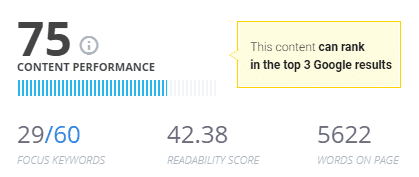
Content tools like those from Searchmetrics, Ryte, or CognitiveSEO help in developing good texts and provide an approximate possible position (which is not to be considered binding because there are more criteria than just the content). Overall, these tools help to create the best article for a keyword (or keyword theme). So, they are real online marketing aids.
Internal Linking
The internal link, i.e., the way internal linking is handled, is a central aspect in presenting the importance of pages. In the meantime, it has become customary to generate so-called pillar pages. These are cohesive, descriptive contents. From the content of the topic, a summary of the most important points is described, which then refer to cluster pages. The cluster pages list and describe more precisely defined sub-aspects of the entire content.
External Linking - How important are Backlinks?
So far, we have not considered the importance of external links. Relevant and as many external links as possible are, however, the best way to improve rankings within Google, Yandex, and Bing. SEO specialists have devised sophisticated link-building strategies that include external links from relevant sites and link exchanges with the most important directories. It is even possible to arrange for external links oneself – if necessary, a link exchange with a competitor can be useful (if desired and feasible).
Improving rankings and thereby achieving a top position in Google is a goal that ultimately cannot be achieved without external links. Above all, it is important to obtain links from websites with a high PageRank whose content is relevant to your own content.
This is very difficult and requires corresponding research, but it is achievable through search engines like Google.
Furthermore, it can be useful to prepare secondary information on secondary and tertiary websites. If these are not identical to your own content, this can have a corresponding effect over time.
LINKS – Backlinks are the strongest ranking factor
Relevant and as many external links as possible are the best option. They help to improve rankings within Google, Yandex, and BING – up to position 1. Our link-building strategy includes external links from relevant sites. Links on appropriate portals, blogs, etc. OffPage SEO is a ranking component that ensures relevance. Suitable linking increases the relevance of the article.
SEARCH ENGINE SUBMISSION
A manual search engine submission to the most important search engines and directories, such as Google, BING, Yelp, and other high-quality search engines, increases visitors to your websites. Automatic submission by submission software is now considered SPAM by many search engines, so we make sure to manually submit your website. This enables us to adhere to the guidelines of each individual search engine – so that you will be found better in the future.
The same applies especially to our Local SEO measures, which help you to reach position 1 in the search results of other directories. For Google, this is no longer necessary in the meantime, as Google finds websites independently. However, submitting to Google still makes sense if you want to improve your Google ranking, this is done in conjunction with the Google Search Console. Because in the Search Console, there is information that allows for a very good optimization of the content.
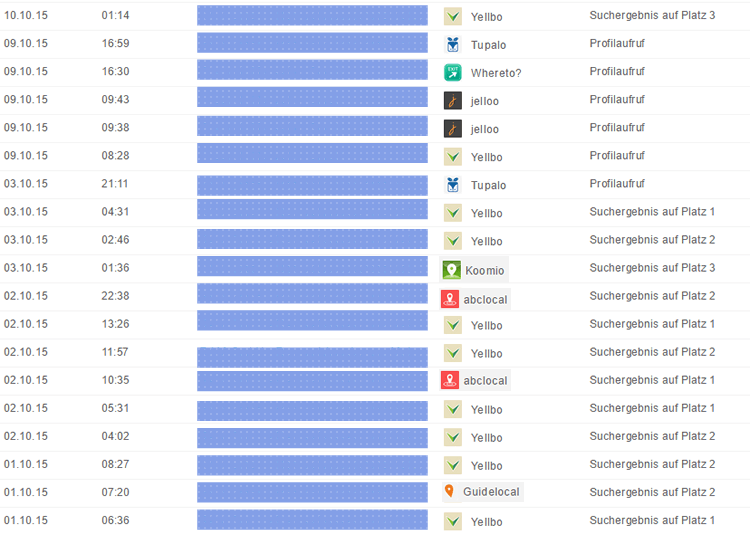
DIRECTORY ENTRIES
We submit your website to free directories, such as the Opening Hours Book. Through years of experience, we have compiled a list of directories that are highly effective for search engine marketing. Depending on the project, we also consider the appropriate directories so that business websites do not end up in entertainment directories.
ARTICLES, PR, NEWS, AND BLOGGING
We have the expertise to create search engine-relevant articles for your PR. Whether it's an article for a website, a blog post, PR for one of the numerous PR search engines, or an article for an encyclopedia website – we ensure that this article is published. We take care not to violate Google's duplicate content issue. In the past, NEWS sites have often come under fire and should only be used if the link is definitely "nofollow." If in doubt, it is advisable to devalue a news portal via Google's Disavow File.
Disavow refers to the ability to declare links invalid to Google.
If there is a manual action due to unnatural links to a website or if one fears a manual action because rankings for certain content, pages, or sections of a domain are declining, these should be reviewed.
There may be a manual action due to unnatural links to your website or due to paid links or any other form of abusive use of links. These violate Google's quality guidelines. If such links cannot be removed, they should be declared invalid (disavow).
Also commonly used in connections like: Disavow File, Disavow-Datei etc. Further information: Evaluate backlink risks and devalue with Disavow File.
Overview of all ranking factors

A big thank you to SingleGrain for compiling this valuable information. Here's the source link: https://www.entrepreneur.com/growing-a-business/a-look-at-googles-200-search-ranking-factors-infographic/226884
Google My Business - now Google Business Profile
All Key Points for Google My Business
Information and Listings in the Entry:
- Company information must be accurate
- 1 keyword in the title is possible, but beware – it violates the guidelines!
- Verify and validate address (through code to become admin)
Reviews, Questions, and Answers:
- Ask customers for reviews and request them to share pictures of the company
- Ask Local Guides for reviews (Note! A Local Guide should have visited the location. It's not very helpful to find a Local Guide from Munich for a review in Schleswig, where they've never been).
- Respond to questions and reviews
- When facing negative reviews: stay calm! Sfc = stay fucking cool ;)
Photos and Videos:
- Add videos
- Include pictures in every category (Team, Interior Shots, Exterior Shots, etc.)
Google+:
- Keep it active, even if few people read it (and it's actually discontinued for private use by Google)
Website:
- Connect with Google My Business Listing
- Name, address, phone number must be identical on website as in GMB listing
- Backlink to the Google My Business entry from the website
Additional Factors Influencing Ranking
Searchmetrics compiled the most important factors in 2015 and the change from the previous year into a very nice and clear infographic.
Generally, these are still largely relevant as fundamental success factors. Aligning with these can help generate quality content that ranks.
The other key success factors include:
- Relevant keywords related to the topic
- Number of words used
- Proof terms
- Click rate
- Mobile design
- Time visitors spend on the page
- Domain visibility
Much has changed since then. The approach we had in 2015 is no longer entirely current in 2022. Information and tips are subject to constant change. This constant evolution often means that information found on Google is outdated and in need of revision.
The basic message of the factors may still hold true - which is why we include the infographic in the article - but the weighting is different today.
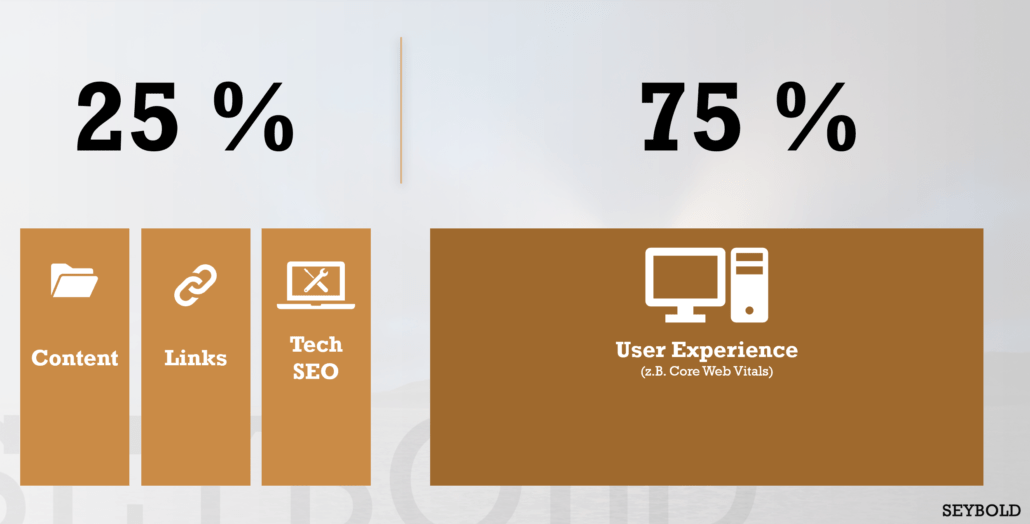
The "soft" factors, which Searchmetrics already took into account back then, have gained much more importance. Factors like time on page, bounce back to the SERPs, and so on are becoming more crucial.
So if we want to improve a website to be better found on Google, here's what we need:
The Three Most Important Ranking Factors
Update (March 2016): In a Hangout (Google Q&A from March 23, 2016), Andrey Lipattsev, Google Engineer, states that the three most important factors for Google ranking are as follows:
- Links
- Content
- Rankbrain
This confirms the often-questioned value of links (internal, outbound, and inbound) as the most important factor alongside content. Content refers to both the structural aspects of the content (H1, H2, bold, text...) and the relevance of the content to the topic.
Rankbrain, originally a filter, is crucial as the third ranking factor because Google receives many search queries every day that have never been asked in exactly that form before. This means that texts, image descriptions, and similar elements must align very well with the keyword and the corresponding keywords (research!!!).
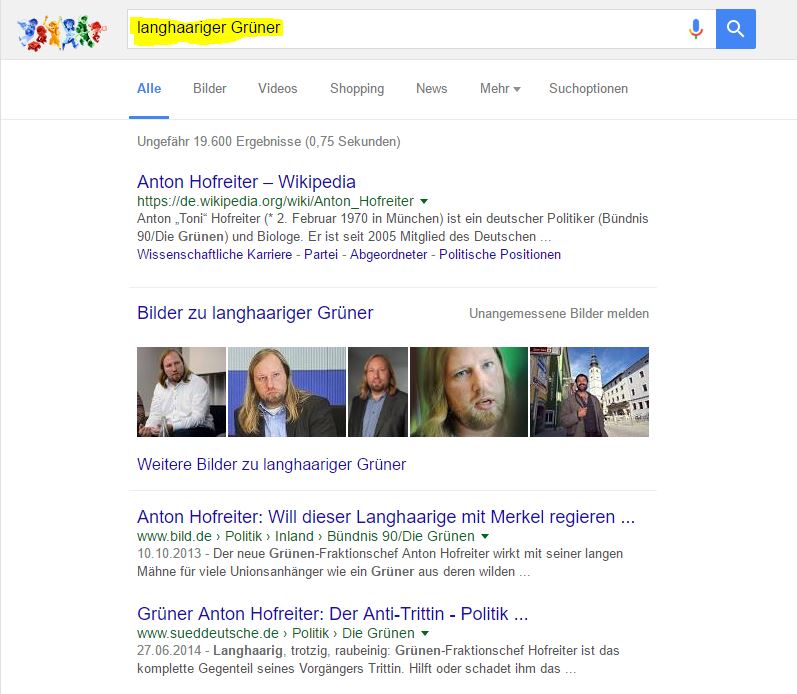
An example of the Rankbrain filter: When you enter "long-haired green" in the Google search, you get various results, such as images and the Wikipedia entry of the member of parliament Anton Hofreiter. He belongs to the Green Party - but nowhere is there any mention of his long hair. So, the text with the combination "long-haired" and "green" does not appear anywhere.
Search Engine Optimization - These Rules Have Applied Since 2017
Since 2017, analyzing rankings for a single keyword is no longer recommended. It used to be common practice to optimize each webpage for a single keyword. However, now it should be analyzed for a keyword theme area. This can ideally be done using the Google Search Console, where all search queries can be thoroughly examined.
To reach page 1, the following points have been considered good principles since 2017:
- Good and clean links enable a website to reach the Top 10 - that is, page 1 of Google.
- On-page optimized content and user behavior are crucial factors in determining where the website will rank among the Top 10.
- Improving user behavior becomes a more important ranking factor.
Links Are a Ranking Signal
SEMrush Study 2.0 Confirms Links as a Ranking Signal
The ranking study also identifies the following important ranking factors (see Links confirmed as ranking factor).
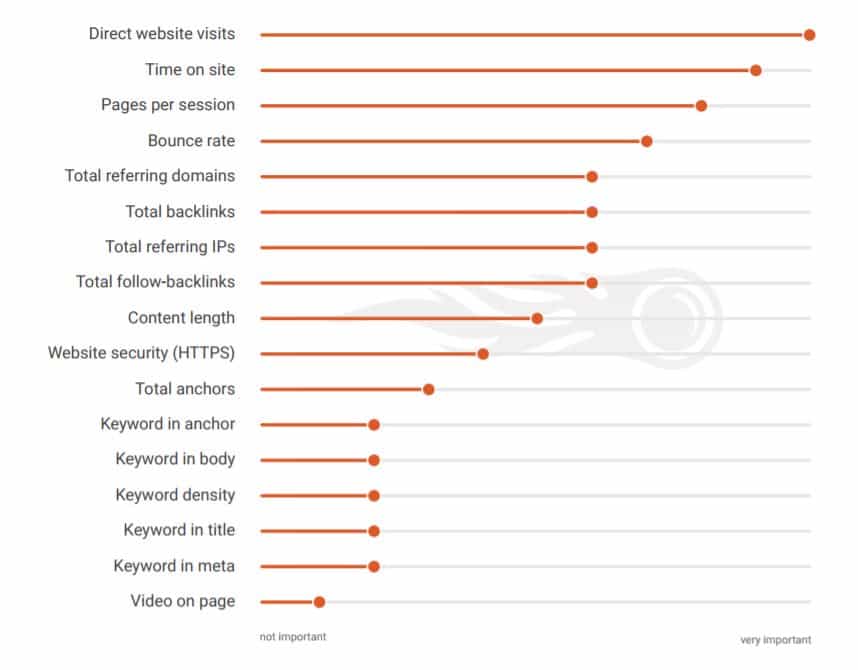
Source: SEMrush
Additionally, website usability and user behavior are becoming increasingly weighted ranking factors.
Improving Google Ranking: Here are the key criteria for a Top 10 positioning:
Improve Google Ranking - Top Criteria for a Top 10 Ranking
Mobile First - Why a Mobile Website is Important for Ranking
In the fall of 2017, Google began transitioning its index to Mobile First. Mobile First follows the trend of an increasing number of searches being conducted on mobile devices. However, these users have different requirements compared to those searching from their office desktops.
The website must load quickly, display properly on mobile devices, and direct internal links to pages that are mobile-friendly.
Since Google is shifting the internal index from desktop to mobile, preparing the website for mobile use becomes more important. According to John Müller, Google's Web Trends Analyst, the index will not be transitioned all at once but gradually.
This is mainly because website visits and the capturing of their content (crawling) have become extremely valuable over time. If each of the billions of websites had only one page, this might still be feasible. However, since many pages have hundreds or thousands of subpages (think of Wikipedia, for example), quickly capturing websites poses a temporal challenge. Therefore, the faster a page can be loaded, the more pages can be included in the index per crawler visit.
Is my website already in the mobile index? How to determine if your website is already in Google's Mobile First Index?
In the Google Webmaster Hangout below, John Müller explains that you can determine if the website has already been included in the mobile index based on the log files. If the ratio between Desktop Googlebot and Mobile Googlebot is still at 80% to 20%, then this is not yet the case. Over time, the ratio will shift in favor of the mobile Googlebot. Then it can be assumed that the website is listed in the mobile index. As of mid-2020, it is not yet possible to speak of an exclusive mobile index.
Mobile First Indexing
Test Mobile Site Usability
How to Test if Websites are Mobile-Friendly?
To test if a website is mobile-friendly, you can use this page from Google (Google mobile friendly test).
For more information on Google Mobile-First Indexing, visit this page from Google: https://developers.google.com/search/blog/2016/11/mobile-first-indexing?hl=de
Google Core Web Vitals: What You Need to Know
Google announced Core Web Vitals as ranking factors six months before their introduction in 2021. Core Web Vitals are metrics reflecting website user experience, aiming to track and improve user experience. The focus is on the technical level. It is recommended to address Core Web Vital updates as soon as possible, as optimizations are complex and time-consuming. Early optimization also enhances customer satisfaction. Websites with fast loading times and user-friendly interfaces not only positively influence the Google algorithm but also increase user satisfaction.
More about Core Web Vitals.
Improving Rankings with CTR Manipulation. Is it Possible?
CTR refers to the click-through rate between the number of times a listing appears in search results for a search term and the number of times it is clicked. Sistrix has demonstrated that the average click-through rate (CTR) for the first position in Google search results is 28.5%. Depending on the search intent (and thus the layout of the destination page), the CTR for Position #1 varies between 13.7% and 46.9%. The SERP layout displays different results depending on the search intent.
A search where the user expects images displays a carousel of images at the top. If the search intent is associated with a purchase, shopping ads or AdWords appear. If the most desired result is a video, video carousels are used.
CTR drops significantly from the second position onwards. Only 15.7% click on position 2, and position 3 is clicked by only 11%.
Only 2.5% of searchers click on the tenth result on average.
Therefore, it is tempting to try to influence the click-through rate to change Google search results. CTR manipulation involves a number of virtual visits and information used to improve Google results for one's own site (or worsen them for a "competitor" site).
CTR manipulations have become very difficult and expensive to carry out. To learn more about CTR manipulation, read our article: https://seybold.de/ctr-manipulation/
SEO Agencies Take Care of Optimization
The best way to optimize your website is to collaborate with a reputable SEO agency. SEO changes almost daily, and no in-house SEO can cover as many different scenarios and develop solutions as an SEO agency can.
What Does SEO Cost?
The cost of SEO depends on
- Industry, topic, and niche of the company
- Website status (best determined by a visibility analysis)
- Quality of the link profile (good links vs. bad links; Link Risk Management)
To plan budgets accordingly, we have compiled the following cost overviews and calculators:
- Marketing Budget Calculator (How to calculate online measures within your budget)
- Cost of a Link Audit
- What Does SEO Cost?
- Top 10 Free Tools to Improve Your Website
- 9 Resources for Free Images on the Web
- Free E-Book for SEO and Visibility Management
Further Information for Achieving Top Rankings and Optimization
https://searchengineland.com/google-won-pr-battle-seo-thats-good-thing-232761
https://searchengineland.com/half-of-google-search-is-mobile-232994
https://blog.searchmetrics.com/us/ranking-factors-2015/
Click Probabilities in Search Results
Which position between 1 and 10 has the best click probabilities and which position is rather poor?
What Should SEO Cost?
What are the costs of search engine optimization? What costs should be calculated?
How to Improve Website Visibility for More Clicks?
How to find the right page for optimization to avoid keyword cannibalization?
The topics listed here are essential for achieving higher rankings in the Google search engine and other search engines sooner or later. Achieving a ranking in Google without AdWords is the goal of organic optimization. However, it's not always possible without Google AdWords. Especially for pages where you want to make money (e.g., also with Google Adsense), it's important to be at the forefront both organically and in advertising. SEO optimization without suitable SEO tools is almost impossible and has become increasingly difficult.
For those who can help themselves - for example, with these tips - tools like Sistrix, Xovi, CognitiveSEO, Ryte, or - for larger budgets - Searchmetrics are recommended. However, good results can also be achieved in online business with inexpensive tools. Content marketing tools help. A new article can be well positioned and rank well with them. Social media marketing helps position good articles in social channels, which also helps generate links.
The topic of SEO is so diverse that we have been continuously updating this article for many years. It is intended to remain the best resource for providing you with SEO tips to achieve good rankings.
FAQs
How can I improve my Google ranking?
On the page, your keyword should be in the right places to indicate relevance to the Googlebot.
This includes:
- The keyword should appear in the URL.
- Good heading structure. The keyword and relevant additional information should appear in the structured headings h1, h2, h3, etc.
- The important keyword should be in the first paragraph of the text.
- Within your website, you should link precisely with this keyword to the corresponding page.
What does "SEO optimized" mean?
This refers to the optimization of a webpage's content for search engines. It's known as Search Engine Optimization (SEO).
During optimization, the content is tailored to be relevant to the topic and of maximum value to the user. There are over 200 factors that determine a ranking, with the most crucial ones being content and backlinks.
How much does SEO cost?
Search engine marketing encompasses more than just optimizing the website for search engines; it also includes activities like link building, on-page optimization, content optimization, increasing visitor traffic, and more. The costs for SEO vary greatly depending on the experience of the service provider. In Germany, costs range from 50 euros per hour to sometimes over 200 euros per hour. Typically, billing is done on an hourly or daily basis. A good agency will provide you with a plan and/or an SEO scorecard to assess the current state of optimization.
How long does SEO take?
Short-term measures, such as AdWords optimization or click-through rate (CTR) optimization, typically yield results within 2 - 4 weeks. For on-page SEO, it's advisable to consistently allocate a fixed amount over at least 12 months (some agencies even recommend 24-month contracts). Backlinks start to show their effect after approximately 3 - 4 months.
How much does a click cost on AdWords?
The costs for a click on a specific keyword can be found in the Google Keyword Planner. Many SEO tools also provide click costs in the keyword research overview. However, it's important to consider that these values are not currently maintained by Google and may not be 100% accurate. Our article on Good CTR AdWords demonstrates what constitutes a good value for click frequency in AdWords.
What is SEO and SEA?
The measures for optimizing a website include SEO (Search Engine Optimization) and SEA (Search Engine Advertising) as components of SEM (Search Engine Marketing). You can also find information on What is SEO here.
What is a backlink?
The definition of a backlink is a link from an external website to one's own webpage. Ideally, this link should be related to the topic and relevant to one's own content.
What is an SEO agency?
SEO agencies assist businesses in improving their ranking on Google or other search portals. The central theme is to enhance and optimize the visibility of the client, ensuring they are easily found through digital channels.
SEYBOLD is the number 1 SEO agency in Stuttgart and the surrounding area (according to SEO comparisons) and is among the top 100 SEO service providers in Germany (Hightext Verlag survey).
What factors can you use to improve a Google ranking?
Google ranking can generally be improved by optimizing the content, backlinks, and technical setup of the websites. This includes titles and descriptions, as they are the first pieces of information a user sees about your website.
Which keywords are relevant for ranking?
Generally, each page should be optimized for a specific keyword. The issue arises when many pages focus on the same topic, leading to keyword cannibalization. Ideally, keywords with a good search volume should be selected.
The ideal strategy for most websites is as follows:
- Select relevant keywords (search terms) with high search volume.
- Use multi-word search terms (long-tail keywords) to support rankings.
- Target keywords with a high number of search queries.
For which keyword should the subpage rank or have a ranking?
The days of simply posting a text on the internet and calling it good are long gone. Today, it's much more important to carefully consider which keywords and content you want your website to rank highly for in search results, right from the start of creating a text.
In the analysis, it's crucial to:
- Check which keywords have rankings in search engines (examine search results).
- Text: Identify keywords that are heavily text-based.
- Keywords in images: Determine which keywords should be used in the alt tags of images to achieve a Google ranking.
- Decide whether the page needs subpages and how both the internal linking and external backlinks should be associated with these keywords.
Often, these tasks can be accomplished with professional tools. It's important to invest ample time in research. Also, remember to:
- Analyze the subpages of competitors.
- Examine keywords that are ranking (e.g., with competitors).
- Consider factors for text and keywords in images.
Long-tail keywords can help gain a significant advantage over the competition.
How do I solve problems with harmful backlinks?
Toxic backlinks must be identified through a professional audit. Backlinks are often underestimated. However, we shouldn't forget that since September 2016, when the Penguin update became part of the core update, every Google update automatically includes a link update.
How do I check my current rankings on Google?
Monitoring your rankings on Google is essential and can be done using a variety of tools, ranging from inexpensive to free or high-priced ones. The specific tool you choose is essentially irrelevant.
What's more important is that, as part of keyword monitoring for Google, you must:
- Monitor the relevant keywords for which you rank
- Monitor the relevant keywords and positions of your competitors
These keywords should be regularly checked.
The advantage of keyword monitoring for the most important search terms is that it allows you to observe the following topics:
- Negative SEO - Issues (such as ranking losses without a real reason, e.g., due to bad links or content spam)
- Competitor analysis: Which websites are ranking better?
- The impact of Google updates on search engine result page (SERP) positions