
The 7 Most Important SEO KPIs
SEO KPIs (Key Performance Indicators) are crucial for monitoring the effectiveness of SEO efforts. KPIs help monitor optimization processes and derive necessary new actions. These metrics must be tracked over time using the same tools to provide meaningful insights. Seasonal fluctuations must also be considered in the analysis.
Among the most important SEO KPIs are OnPage and OffPage signals:
- Visibility trends and search engine rankings
- Organic traffic
- Conversion rate
- CTR (Click-Through Rate)
- Bounce rate
- Session duration, depth, and average time on site
- Referral traffic
What are KPIs?
SEO KPIs (Key Performance Indicators) help us measure the success of search engine optimization efforts by providing essential metrics.
They help us optimize access to a page.
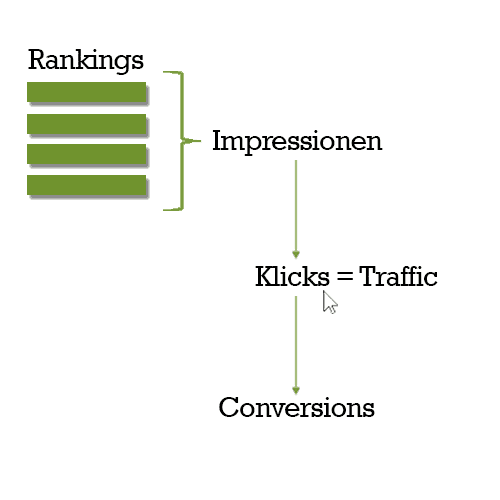
In brief: Through rankings, we gain impressions (how often the page is displayed in search results). Ideally, these impressions are clicked, resulting in traffic to the website. If the website functions correctly for the user—providing what they are looking for—they interact with it, ideally becoming a customer. This leads to conversions.
Simply viewing visitor numbers is not very meaningful in this context. Without conversions and interaction, we do not know what works well on a website and what does not.
From ranking to conversion.
What are the Key KPIs to Consider?
We categorize KPIs into general SEO metrics, business metrics, and social metrics. Here are the key points to consider:
| General SEO Metrics | Business Metrics | Social Metrics |
|
|
|
Determining Desired SEO KPIs
Therefore, we determine the metrics based on well-performing websites and ask important questions such as:
- Why do users prefer to click through a website?
- Why do visitors become customers here?
- Which content works better here compared to another website?
Examples
We ask different questions for each topic and objective.
Online Shop: Product descriptions, SEO texts, and images have been improved.
Are there improvements in access and click rates (general SEO metrics)? Is there an increase in the number of products sold (business metrics)?
Brand Awareness: Social media advertising, visitor tracking.
Is there an increase in likes and shares (social metrics)? Is there an increase in visitors from referring sites (general SEO metrics)? Is the brand gainin
Organic Traffic
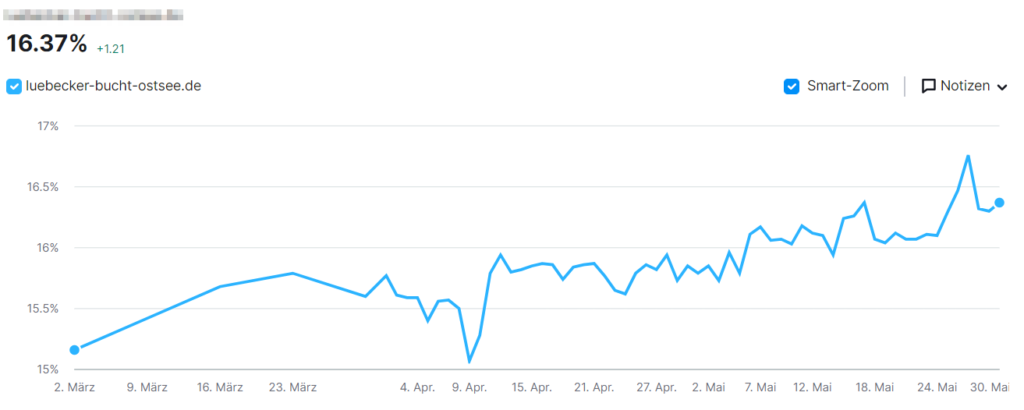
Traffic, the number of page views from organic search, offers a variety of detailed insights. This metric allows for evaluating:
- Which weekdays/monthly days attract the most visitors?
- How does visitor count change across different time periods?
- Which pages are of interest to visitors?
- How does traffic behave compared to performance or social media channels?
- Through which keyword do most visitors get generated?
These insights can be further refined by considering factors like country of origin, language, or device.
A good starting point for such analysis is Google Analytics or the performance reports in Google Search Console.
Conversion Rate
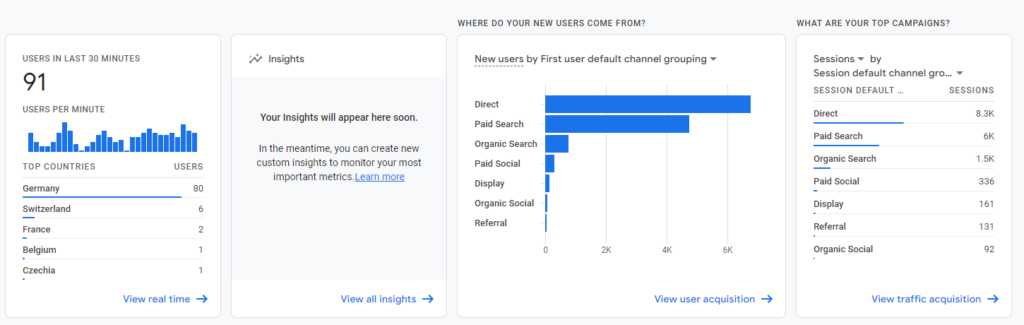
The Conversion Rate indicates the percentage of website visitors who have achieved a predefined goal on the website. It records user actions for evaluation purposes.
Such goals may include:
- filled out contact forms vs. submitted contact forms
- shopping carts vs. orders placed
- newsletter sign-ups
- clicks on specific elements on the website
These goals are also trackable and measurable through Google Analytics.
CTR (Click-Through Rate)
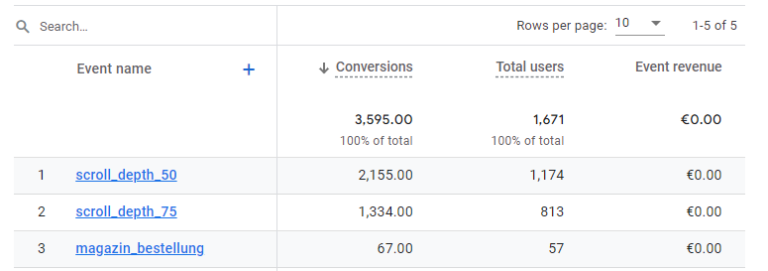
CTR is the percentage ratio between clicks and impressions. This number indicates how often a website is clicked in relation to how often it is shown. For example, a page might be displayed 1,000 times in a search over a period of 30 days but only clicked 10 times. In this case, the CTR is 1%.
The click-through rate measures how successfully individual keywords work in conjunction with the target page. It shows which pages and keywords are clicked frequently and which are not. This metric also provides insight into how well the page title and description are working, or whether Google is using the specified values for title and description.
The click-through rate gives information about how well a specific subpage performs for a particular keyword. As an SEO KPI, it is an important performance factor. CTR manipulation can be evaluated through such an analysis, and it can also show whether Google is currently testing a specific page in the top ten.
These data can be analyzed in the Search Console. For example, our article on CTR in AdWords shows the CTR achieved in different industries.
Bounce Rate
The bounce rate can also be evaluated using Google Analytics. This metric shows how many visitors leave the page without taking any action. It reflects all visitors who immediately leave the page because they find that it doesn't contain the content they were looking for.
The bounce rate measures user behavior, which is influenced by factors such as:
- Layout (a poor layout leads to a higher bounce rate)
- Performance (long load times cause users to leave)
- Poor content (too little, too much, or irrelevant content)
- Too many ad banners
- Unclear navigation
- Wrong keywords (mismatch between search and result)
Session Duration, Depth, and Average Time on Page
When analyzing user behavior, it’s important to consider metrics such as page depth, average time on page, and session duration.
These data provide insights into how engaging a website is for users. They show how many pages a visitor views (session depth), how long they spend on each page (session duration), and what the average time spent on different sections of the website is.
This information helps improve the usefulness of a website.
Referral Traffic
Visits from external websites help assess the quality of content seeding. While other factors, such as improving the link profile (Power*Trust on each page), are important, good content seeding also shows how many visitors come from other websites. This is becoming an increasingly important aspect because backlinks from high-traffic websites offer a good opportunity for those visitors to convert on your site. If the linking site’s topics align with your own, these visitors are more likely to complete a purchase or fill out a form on your site.
Suitable Tools for Measuring KPIs
In search engine optimization (SEO), there are a variety of tools you can use to measure Key Performance Indicators (KPIs). These KPIs include, among others, organic visibility, traffic, keyword rankings, backlinks, page load speed, and many other metrics. Below is an overview of the most common tools you can use to monitor your SEO KPIs:
Google Search Console
- Purpose: Monitoring search performance and analyzing organic clicks, impressions, CTR (Click-Through Rate), and keyword positions.
- KPIs:
- Organic Traffic
- Keyword Rankings
- CTR
- Page Indexing
- Technical SEO Issues (e.g., crawling errors)
Google Analytics
- Purpose: Analyzing user behavior and traffic sources on your website.
- KPIs:
- Organic Traffic
- Session Duration
- Bounce Rate
- Pages per Visit
- Conversion Rate (for organic traffic)
SEMrush
- Purpose: All-in-one tool for keyword analysis, competitor analysis, backlink analysis, and monitoring website health.
- KPIs:
- Keyword Rankings
- Competitor Comparison
- Visibility Index
- Backlinks and Referring Domains
- Organic Traffic
- Technical SEO Optimizations
Ahrefs
- Purpose: Primarily used for backlink analysis, keyword rankings, and competitor analysis.
- KPIs:
- Backlinks and Domain Authority (DR)
- Keyword Rankings
- Organic Traffic
- SEO Visibility
- Content Gap Analysis
Moz
- Purpose: Tracking keyword rankings and backlink analysis.
- KPIs:
- Domain Authority (DA)
- Keyword Rankings
- Backlink Analysis
- Page Optimization
- Organic Visibility
Sistrix
- Purpose: A widely used SEO tool in Europe, especially strong in visibility analysis and competitor monitoring.
- KPIs:
- Visibility Index
- Keyword Rankings
- Backlink Analysis
- Competitor Analysis
- SEO Error Analysis
Screaming Frog SEO Spider
- Purpose: Analyzing the technical SEO aspects of a website by crawling.
- KPIs:
- Page Load Speed
- Internal Linking
- Meta Tags, Titles, and Descriptions
- Redirects and Error Pages
- URL Structure
Majestic
- Purpose: Specializes in backlink analysis and evaluation.
- KPIs:
- Backlinks
- Trust Flow (Backlink Quality)
- Citation Flow (Number of Backlinks)
- Referring Domains
PageSpeed Insights (Google)
- Purpose: Analyzing page load speed and performance for both desktop and mobile.
- KPIs:
- Load Time
- Core Web Vitals (LCP, FID, CLS)
- Optimization Recommendations
Ryte
- Purpose: SEO analysis tool for on-page optimization and technical SEO.
- KPIs:
- Visibility Index
- On-Page Errors
- Site Structure
- Load Times
- Technical SEO Issues
Serpstat
- Purpose: SEO tool for keyword analysis, backlink tracking, and content analysis.
- KPIs:
- Keyword Rankings
- Visibility
- Backlink Analysis
- Website Health
Google Tag Manager (GTM)
- Purpose: Implementation of tracking tags and capturing specific user behavior data.
- KPIs:
- Event Tracking
- Page Views
- Clicks on Specific Elements
- Conversion Tracking
Ubersuggest
- Purpose: Keyword research, backlink analysis, and competitor analysis.
- KPIs:
- Keyword Rankings
- Backlink Analysis
- Content Ideas
- SEO Difficulty
Conclusion
These tools help you measure and optimize the most important SEO KPIs such as visibility, traffic, load speed, backlinks, keyword rankings, and user behavior. The choice of the right tool depends on the specific requirements and goals of your SEO strategy.
To measure SEO success, we determine various metrics based on critical business questions, which define the KPIs used in the report.
By comparing and setting goals, whether for more sales or increased brand awareness, we can measure key areas and optimize what isn’t working well yet.
It is advisable to conduct monthly SEO reports, ideally with competitor benchmarks, to track progress. Monthly calls and regular reviews (semi-annually) to assess profitability are also recommended.
Additionally, a regular crawl of the website (weekly or bi-weekly) is advisable to detect technical and content-related issues early. Monitoring website availability helps detect when the site is down or responding with errors, and also identifies unwanted changes in titles, meta-data, etc.
These KPIs can be delivered as a PDF report or as a continuously available dashboard via Google Data Studio from the agency.
Additional useful information:
- 8 Common SEO Mistakes – And How to Avoid Them
- Measuring Content Marketing: 4 Ways to Evaluate Content
- Checklist: How to Get Your Content Found and Clicked
- Negative SEO Attack and How to Recover
- 5 Reasons to Hire an SEO Agency
- Strategic SEO – 7 Tips for a Better SEO Strategy