AI Overviews: What This Means for Your SEO Strategy
AI Overviews rely on Google's regular search index, so classic SEO fundamentals remain the basis of any visibility strategy. What's shifting is the priority: instead of individual ranking positions, what now counts is whether content works as a citable answer passage. Measuring success requires the Generative AI performance report in Search Console combined with Analytics or CRM data — otherwise the effect on leads and revenue stays invisible.
Strengthening visibility for AI search
SEYBOLD ONE builds data-driven strategies for better search engine and AI visibility, technical SEO, and content that gets seen.
Get a free consultationWhat are Google AI Overviews? Definition and distinction
AI Overviews are summaries generated by Google that appear directly in the search results and condense multiple sources into a single answer. They show up where a single web page wouldn't fully answer the query — for questions with several sub-aspects, for example, or for comparisons. Google itself describes in its documentation on AI features and your website that these overviews draw on links from the search index and don't represent a separate ranking mechanism with new rules.
It's important to distinguish this from related formats that are often confused with it:
- Featured snippets show a single, verbatim text excerpt from one source, whereas AI Overviews combine multiple sources into a new, generated answer.
- AI Mode isn't an overview within the classic results list, but a standalone, conversational search interface with follow-up questions and multimodal input.
- Classic organic results continue to exist in parallel — AI Overviews don't replace them, they add a summary ahead of them.
AI Overviews typically appear for explanatory questions ("how does… work"), for comparisons between several options, or for multi-layered topics that would require research across several sources. For simple, transactional, or strongly local queries, the classic results list often stays unchanged. Teams who want to dig deeper into the differences between AI search formats will find it useful to look at our comparison of AI search engines.
How do AI Overviews work technically? RAG, grounding, and source selection
Technically, AI Overviews are built on a principle known in the field as Retrieval-Augmented Generation, or RAG for short. The language model doesn't generate the answer purely from its trained knowledge; instead, it first retrieves matching documents from the search index and bases its wording on those findings. This process is called grounding: the generated statement is anchored to real, current web content instead of relying on outdated or unverified model knowledge.
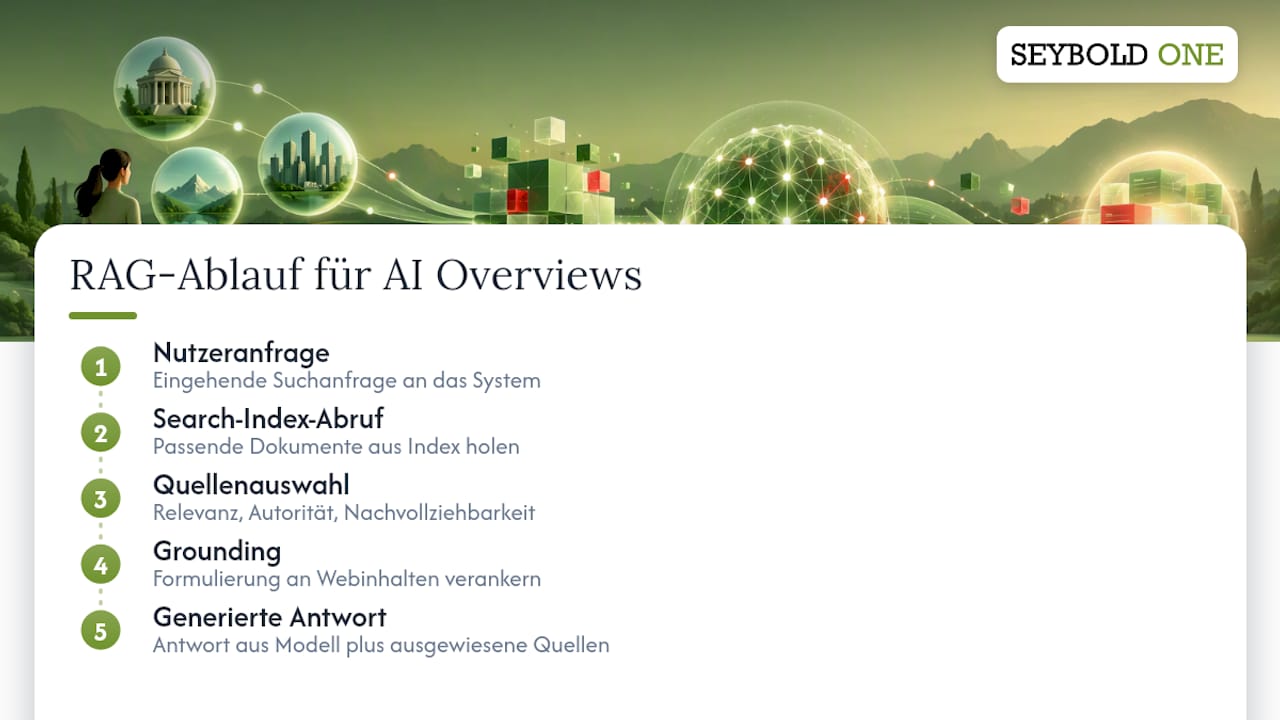
According to Google's guidance on optimizing for generative AI features, there are no new, secret criteria for how supporting links are selected. What matters is relevance to the query, a certain level of authority for the source in its field, and traceability of the claim — that is, whether a statement is clearly supported in the visible text and can be clearly attributed to a page. As Google puts it: content with clear, verifiable evidence and unambiguous answers has better odds of being cited, regardless of any special technical tricks.
This has a consequence that surprises many SEO teams at first: there is no special markup trick that guarantees inclusion in AI Overviews. Structured data can help mark up content more clearly for search engines, but according to Google it's not a required element and never replaces visible, indexable text. Anyone hoping for a new schema attribute or a special meta tag that automatically generates citations will be disappointed. What matters is the same foundation as always: content needs to be crawlable and indexable, it actually needs to be present in the HTML rather than loading only after interaction, and it needs to be precise enough to function as a standalone answer. Technical hurdles like content that loads with a delay can become a real visibility problem here, as our analysis of delayed-loading content for Googlebot shows in detail.
When are AI Overviews shown? Triggers, eligibility, and display rules
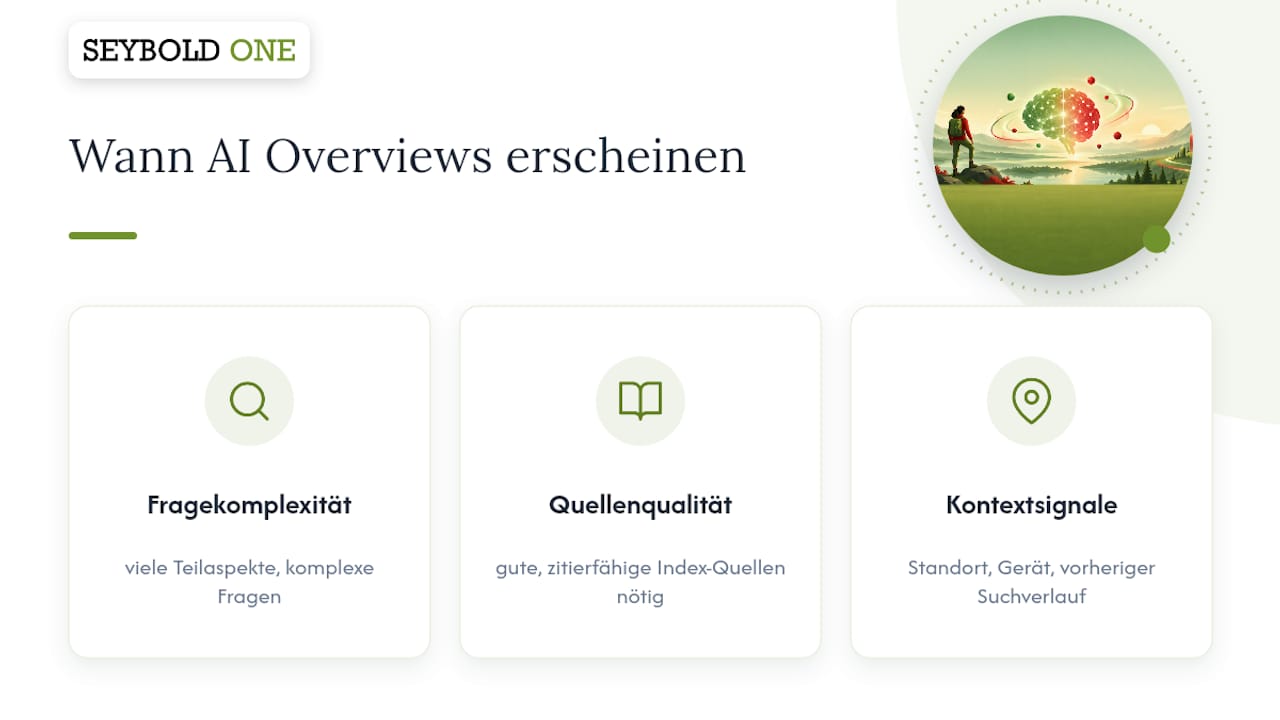
Google only shows an AI Overview when it offers real added value compared with the classic results list — not automatically for every query. This eligibility decision depends on several factors that are hard to predict fully in practice, but can be roughly outlined.
One central factor is the complexity of the query: the more sub-aspects a question has, the more a summarized answer is worthwhile for Google instead of ten blue links. Just as important is the availability of enough good, citable sources in the index on that exact topic. If solid, clearly written content is missing, the classic results list often remains the better option for Google, even for complex questions. On top of that come user and context signals like location, device type, or prior search history, which influence whether an overview is judged helpful.
In practice, this means: optimization effort pays off above all where your audience asks complex, multi-layered questions and where you already have precise, current expertise. For simple, unambiguous queries with a clear answer, you're better off investing your resources elsewhere, since an overview is rarely shown there anyway.
Impact on traffic and click behavior: what the data and Google say
The most noticeable effect of AI Overviews concerns click behavior. Users click links less often when an AI summary already provides an answer directly in the search results, as a short analysis by Pew Research from July 2025 shows.
Users click links less often when an AI summary appears — an effect that can be understood as reinforcing the so-called zero-click phenomenon, and one that increasingly calls classic click counts into question as a sole success metric.
That doesn't mean, however, that the conversion pipeline automatically gets worse. Anyone cited for a query reaches users who might not have clicked anyway, but who become aware of the brand and search for it specifically later. For SEO teams, this shifts the focus to other metrics:
- Qualified traffic instead of raw visitor numbers: anyone who still clicks after encountering an AI Overview often has a more concrete interest.
- Engagement time on the landing page as an indicator of whether the remaining traffic is actually relevant.
- Conversion rate instead of click-through rate as the yardstick for a page's business value.
This shift calls for a rethink in how content success is evaluated. A page that holds a stable or rising conversion rate despite falling clicks is still working well economically, even amid the zero-click trend. Anyone who chases pure visibility in AI Overviews without checking the downstream effect is optimizing past the actual business goal. Google itself notes in its guidance that its own Generative AI performance report does show impressions and clicks for AI features, but doesn't replace company-specific measurement of leads or revenue — more on that in the measurement section.
Practical checklist: prioritized SEO actions for AI Overview visibility
From the technical and strategic context, a sequence of actions emerges that has proven itself in practice. It follows a clear logic: secure the fundamentals first, then sharpen the content, then expand the structure.
- Write the core answer first. Put the most precise, shortest answer to the main question directly and visibly in the text before context and details follow — the way this very section does.
- Make it traceable. Make the author, date, and evidence for key claims visible in the text itself, since without clear attribution, a statement's odds of being cited drop significantly.
- Check indexability technically. Review robots directives, CDN configurations, and whether key content is present in the initial HTML rather than only loading later via scripts.
- Keep structured data consistent. Structured data must match the visible content exactly; discrepancies between markup and text weaken a page's trustworthiness.
- Build brand authority continuously. Google's guide to preferred sources shows that users can choose their own preferred sources, which makes brand recognition more important long-term than short-term optimization tricks. Building this kind of topical authority is covered in more detail in our article on the Authority Loop.
- Align information architecture with follow-up questions. Since AI Mode works conversationally and asks follow-up questions, plan content as connected answer bundles rather than isolated single-keyword pages.
Pro tip:Test a revised answer passage on a single high-search-volume page first, before rolling the format out across the entire site.
This order is deliberately prioritized: a page with perfect structured data but poor indexability accomplishes nothing. Conversely, a technically flawless page without a clear, well-supported answer passage barely helps its odds of being cited either. The combination of all six points is what decides the outcome, not any single lever on its own. Anyone wanting an overview of the general framework of classic search engine optimization will find the fundamentals in our SEO knowledge encyclopedia.
Measurement and reporting: combining Search Console, Analytics, and prompt tracking
Without the right measurement setup, any optimization for AI Overviews is flying blind. The natural starting point is the Generative AI performance report in Search Console, which Google provides explicitly for this purpose and which shows impressions and clicks in the context of AI features.
This report alone, however, isn't enough to judge the business impact. Google itself recommends combining it with your own company data in its guidance:
- Search Console data shows visibility within generative features, separate from classic organic clicks.
- Analytics and CRM data show whether the remaining traffic actually leads to leads or revenue — something raw impression counts can't capture.
- A prompt and SERP panel with repeatedly tested, representative queries makes visible which content format actually gets cited for which question.
For analyzing how AI-feature data can be meaningfully connected with classic marketing metrics, it's also worth looking into Google's own Analytics documentation, which offers further context on linking visibility data with business metrics.
Cluster tracking rounds out this setup: instead of watching individual keywords in isolation, group thematically related queries and check whether a revised answer passage has an effect across the whole cluster or only for a single phrasing. This makes tests reproducible and prevents wrong conclusions from random one-off observations.
EEAT and agency practice: SEYBOLD ONE's approach to AI visibility
Extensive experience in visibility management feeds into this topic area, supplemented by involvement in developing standards such as DIN SPEC 33461. This experience shapes an approach that repeats in practice across several steps:
- Visibility audit: an inventory of which content already qualifies for citable answers and where technical indexability problems exist.
- Prompt and SERP panel: building a reproducible test system across multiple answer systems, to make citation patterns traceable.
- Content revision: reworking existing pages toward clear, well-supported answer passages, following the criteria described in this checklist.
- Monitoring: ongoing observation of visibility across multiple answer systems, not just within classic Google search.
This forensic, data-driven approach targets, in particular, cases where visibility suddenly collapses or never develops in the first place, and draws on extensive experience across numerous clients.
An author's perspective: priorities and common misconceptions
Anyone working with limited resources should stick to a clear order: first ensure indexability, then write citable answer passages, and only after that invest in finer-grained measurability. Many teams reverse this order and build elaborate dashboards before the fundamentals are in place — that accomplishes little.
A common misconception is the belief in technical tricks without lasting value, such as special schema variants or supposedly secret prompt phrasings. Google explicitly refutes this idea in its own documentation: what counts is content quality, not markup alone.
A recommendation for limited budgets: focus first on pages with real conversion potential, not the ones with the highest search volume. A page that rarely triggers AI Overviews but reliably brings in leads deserves more attention than a high-reach page with no business value.
How SEYBOLD ONE can help with AI visibility
Anyone who doesn't want to tackle the steps above alone, with limited in-house resources, can turn to specialized support that follows the forensic, data-driven principles described here.
Particularly well-suited are the ongoing monitoring across multiple answer systems starting at €149 per month, a full visibility audit as an assessment of the current state, or a targeted AI visibility workshop for €1,500 one-time, which equips teams to carry the topic forward themselves. You'll find an overview of all consulting services and pricing on the services page; suitable workshop dates can be requested directly via the workshop overview.
FAQ
Is there an AI that can handle SEO on its own?
There is no AI that reliably handles complete SEO work on its own, though there are tools that support individual sub-steps such as research or draft copy. Final content review, technical implementation, and strategic prioritization remain tasks that require human expertise.
Is SEO still worth it in 2026?
Yes, SEO remains relevant because AI Overviews still rely on the same search index that classic search results use. If a page isn't indexable and content-wise convincing, it won't show up in any AI-generated summary either — the fundamentals of visibility haven't disappeared, they've shifted.
How is artificial intelligence actually used in search engine optimization?
Artificial intelligence is mainly used in SEO for research, draft copy, and analyzing large amounts of data. On Google's side, AI systems also generate summaries directly from indexed content, which requires pages to be crawlable, precise, and well-supported by evidence.
Can ChatGPT fully replace SEO work?
ChatGPT can help with research, drafting, and ideation, but it doesn't replace a complete SEO strategy. Technical indexability checks, assessing structural problems, and measurement via Search Console and Analytics require expert judgment that goes beyond pure text generation.