SEO Basics
What Does SEO Mean?
The abbreviation "SEO" stands for Search Engine Optimization, which refers to the practice of optimizing websites to make them discoverable in search engines like Google, Bing, and Yahoo.
Check out our SEO Wiki for more information!
Objectives and Why SEO Is Important
The goal of search engine optimization is to enhance the visibility of a website. Website owners aim to have their content appear at the top of search engine rankings.
Therefore, it's crucial for the content and offerings to align with user search intent. SEO ensures that web pages appear for relevant search queries, thereby increasing website visibility.
Objectives can vary by industry and company. For example, an e-commerce store prioritizes revenue, while a service-oriented business values contact inquiries via phone or form submissions.
Is Goal Implementation Guaranteed?
Search engine optimization often requires patience as the impact of implemented measures may take time to manifest. Minor changes might be noticeable after 6-8 weeks, depending on the actions taken.
While SEA (provides short-term results), content may take longer (until Google crawls the pages). Backlinks also require 3-4 months to take effect. On-page topics typically show results in about 4 weeks.
Significant changes and reaching the break-even point are typically observed after 12-13 months.
SEO as an Element of Online Marketing:
Search Engine Optimization (SEO) involves online marketing strategies to achieve a better ranking in organic search results. SEO is divided into On-Page and Off-Page practices, including content marketing, technical SEO, link building, local SEO, and more.
Search Engine Advertising (SEA) refers to paid advertisements in search results to drive traffic.
In comparison, Search Engine Marketing (SEM) encompasses all measures to acquire visitors. SEM combines search engine optimization and search engine advertising (SEM = SEO + SEA).
Search Engine Optimization is divided into the following categories:
- Keywording
- Technical SEO
- On-Page Optimization
- Off-Page Optimization
- Information Architecture
- Content Marketing
- Mobile SEO
- SEO KPIs
- Trends
- Black Hat SEO
Keywording
Definition and Benefits
Keywords are terms or phrases entered into a search engine's search bar. The term is processed by search algorithms and compared with the appropriate index, resulting in the search engine results page (SERP) that the user receives.
Keywords can be individual words or combinations of words, numbers, and letters found within the text itself. They are a crucial part of search engine optimization, encompassing all tools and tips for searching terms.
Keyword Classification
Money Keywords
Money Keywords describe transaction-oriented search terms indicating purchase intent. The keyword is not limited to phrases like "book a vacation" or "buy now."
Brand Keywords
Brand Keywords specifically refer to the brand name or variations containing the brand that users search for to access specific brand offers or websites. Examples include "Nike" or "Mercedes."
Compound Keywords
Compound Keywords combine Money Keywords and Brand Keywords, such as "buy Nike shoes."
Other Keywords
Other Keywords include terms that do not fit into the above categories, such as "learn more," "read more," or "download."
Additionally, there are further terms that differentiate between:
Informational, Navigational, Research, and Transaction Keywords.
These are user intentions behind a query. An Informational Keyword seeks specific information without excluding purchase intent. A Navigational Keyword seeks general information, also without excluding purchase intent. The following two types of keywords have definitive purchase intent. The difference is that users utilizing a Research Keyword seek to learn more about a product and its performance, while a Transaction Keyword is searching for a specific purchase opportunity.
Long-Tail & Short-Tail
Another classification of Money, Brand, and Compound Keywords.
Long-Tail Keywords are complex and longer than Short-Tail Keywords, making them less frequently searched.
Short-Tail Keywords, on the other hand, are shorter and typically have a high monthly search volume.
Maintaining a high number of keywords or keyword coverage on a website can quickly facilitate specific rankings, especially on Google. Consistently optimizing Short-Tail Keywords can improve your rankings over time. Furthermore, the four types of keyword classifications, specifically user intentions, should not be neglected.
Keyword Research and Analysis
This involves identifying the phrases and terms users enter when searching for products or services.
Through research, you can align your content with specific keywords and ensure all critical topics are covered.
Additionally, you gain insights into the search volume for these terms and the level of competition in organic search results.
Various tools are available for keyword research, ranging from free to paid.
Some of the most well-known and widely used tools include:
- Google Tools
- Semrush
- Sistrix
- Ahrefs
- MOZ Keyword Explorer
- Ubersuggest
Technical SEO
Technical SEO ensures that further optimization efforts can take effect but is not solely responsible for achieving good website rankings.
Benefits
The goal is to optimize user experience and ensure content is easily discoverable.
Technical SEO also plays a significant role in shorter load times, impacting potential conversion rates.
Possible Measures
- Link structure
- URL optimization
- Crawling
- Secure connections (e.g., HTTPS)
- Source codes
- Server issues
Website Structure and Navigation
A clear and well-structured website design and navigation are crucial for positive user experience and effective search engine optimization (SEO). Easy navigation should allow users quick access to all relevant website pages, while a clear structure helps search engines crawl and index the website more efficiently. Establishing a hierarchy where the most important pages appear prominently in navigation and ensuring concise content on the page are vital. Good website structure and navigation can increase user engagement and boost the likelihood of conversions and sales.
Load Speed and Mobile Optimization
Website load speed and mobile optimization are crucial for successful online presence today. Users expect websites to load quickly and seamlessly across all devices. Slow load times not only impact user experience negatively but also affect search engine rankings, as Google considers load speed a ranking factor.
Google's PageSpeed test allows you to compare your page load time with competitors'.
Mobile optimization is equally important, with more users browsing on mobile devices. A mobile-optimized website automatically adjusts to device screen sizes, offering an optimized user experience. Moreover, Google prioritizes mobile-friendly websites and ranks them higher in search results.
Google's Mobile-Friendly Test is useful for checking if your website is optimally usable on mobile devices.
Crawling and Indexing
Crawling refers to search engine bots scanning a website to collect content and links. Indexing describes how the search engine stores collected content in its index for later display in search results.
Optimal crawling and indexing speed are crucial for ensuring your website is properly indexed and displayed. To avoid issues with crawling and indexing, ensure your pages are not blocked, provide a sitemap.xml, and avoid duplicate content.
Additionally, tools like Google Search Console can help monitor and optimize your website's crawling and indexing speed.
Sitemap
A sitemap is a file listing all website pages, used by search engine bots to understand and crawl a website's structure effectively. It's a vital component of SEO, helping improve website placement in search engine results.
There are four types of sitemaps:
- XML Sitemap: Lists all website URLs in XML format, the most common type of sitemap
- Image Sitemap: Helps search engines find all images hosted on the website
- Video Sitemap: Assists search engines in categorizing video content on the website correctly
- News Sitemap: Used for helping search engines find news content on the website.
Check out our wiki post related to "Sitemap"!
Submit and monitor your site's sitemaps through Google Search Console to ensure proper indexing of all pages.
On-Page Optimization
On-page optimization focuses on content presentation, heading structure, titles, and descriptions. It helps search engines classify your website for specific topics and enhances user experience.
On-page optimization includes:
- Information architecture
- Creative media mix (images, texts, videos)
- Up-to-date, rich, and high-quality content
- Structured data/content
- Internal linking
- SEO-friendly URLs (short and concise)
URL Structure:
www.Domain.com/Path(Directory)
Encryption Subdomain Domain name TLD (Top-Level-Domain) Path Hostname
On-Page Optimization is Not Synonymous with On-Site Optimization
On-site SEO involves improvements affecting the entire domain (website).
On-page SEO, on the other hand, pertains to individual pages of a website.
On-site optimization includes:
- Clear linking & navigation structure
- Encryption (https)
- Error-free code
- URL path definitions
- Descriptive URLs
Off-Page Optimization
Off-page optimization involves internal and external linking. Internal linking refers to referencing another page within the same website, like site navigation. External linking includes mentions (not links, e.g., product and brand mentions) and credibility-building measures such as trust links from reputable and relevant sources.
Examples include backlinks from magazines or blogs with relevant topics.
Goal of Off-Page Optimization
The goal of off-page optimization is to establish the website as trustworthy and credible to users and search engines. Off-page SEO largely aligns with the E-A-T principle and involves indirect measures to optimize search engine rankings.
E-A-T represents Google's quality concept, incorporating aspects of off-page evaluation methods (e.g., PageRank), on-page content evaluation methods (e.g., Panda), and entity evaluations (authors and organizations).
E – Experience = Quality of content.
E – Expertise = Knowledge. Refers to the author's expertise and experience.
A – Authority = Notability of the author.
T – Trust = Credibility. Refers to the author's trustworthiness.
Backlinks
Backlinks are crucial in search engine marketing (SEO), serving as recommendations or references from other websites. They are a significant criterion for search engines like Google to assess a website's relevance and authority.
Quality backlinks can significantly improve a website's ranking in search results. Search engines view backlinks as indicators of a website's trustworthiness and popularity. Backlinks from reputable and relevant sources can enhance credibility and relevance. Relevant traffic resulting from backlinks contributes to improved ranking.
Importance of Backlinks for SEO
Backlinks not only increase website traffic but also influence visibility. Websites with many high-quality backlinks are considered more relevant by search engines and rank higher. This can attract more organic visitors, as websites on the first search result pages receive more attention.
Implementing backlinks requires a focus on quality and relevance. Search engines can detect low-quality or manipulative backlink strategies and penalize websites. It's advisable to build natural and organic backlinks through high-quality content and a strong online presence.
Different Types of Backlinks
Various types of backlinks are utilized for effective SEO:
- Natural Backlinks: Arise when other websites voluntarily link to your content, considering it valuable and relevant.
- Guest Posts: Writing articles for other websites in exchange for a backlink expands reach and gains backlinks from high-quality websites.
- Directory Backlinks: Obtained from web directories or industry lists, improving online visibility but using reputable directories is crucial.
- Social Media Backlinks: Links from social media platforms drive traffic to your website, indirectly supporting SEO efforts.
- Edu and Gov Backlinks: Considered valuable due to high credibility from educational (Edu) or government (Gov) websites.
A balanced mix of backlink types creates a natural link profile and leverages benefits from different sources.
Backlinks don't directly impact immediately. It's intriguing to consider how long it takes for Google links to have a genuine impact on visibility.
Local SEO
Local SEO focuses on improving a company's visibility in local search results. Unlike traditional SEO aiming to enhance overall online presence, local SEO targets specific local search queries. Its primary goal is to boost rankings for local search terms like "cafes in Berlin" or "hair salon in Hamburg" in search engine results.
Importance of Local SEO for Businesses
In an increasingly connected world, local SEO is crucial for businesses. Here are some reasons why local SEO is essential:
- Enhanced online visibility: By optimizing the website and other online platforms, a business becomes more discoverable in local search results. Potential customers searching for products or services nearby are more likely to notice and visit the business.
- Targeted customer acquisition: Local SEO allows businesses to target customers already looking for products or services in their immediate vicinity, increasing the likelihood of converting them into paying customers.
- Increased customer trust: Businesses appearing prominently in local search results inspire trust in potential customers. High search result placement signals to users that the business is established and trustworthy.
- Competitive advantage over large chains: Local SEO empowers small and medium-sized businesses to compete with large chains or national corporations. Targeted local presence highlights uniqueness and individual offerings.
- Mobile and voice search: With the rise of mobile devices and voice assistants like Siri or Google Assistant, local SEO gains more importance. Users frequently seek products or services nearby and expect immediate results.
Key Local Ranking Factors
- Physical proximity: Closer proximity to the search location enhances local rankings.
- Local Pack: Local search results format (companies, not websites).
- NAP (Name, Address, Phone)
- Reviews and ratings
- Google Business Profile
- Local keywords
- Citations: Include business location information like name, address, phone number, and website on online platforms and your own site (e.g., footer or contact page).
Google Business Profile
Google Business Profile acts as a digital business card. Creating a business profile allows important information like opening hours, contact details, and a brief business description to be displayed. Additionally, images, reviews, and posts can be added to make the profile appealing and up-to-date.
One significant benefit of creating a business profile is increased visibility in Google search results. When potential customers search for a specific business or service, relevant information is displayed directly on the search results page. This can drive more traffic to the website or store.
Interaction with customers is another critical aspect. Through GBP, customers can leave reviews and ask questions, allowing businesses to engage directly and demonstrate responsiveness to customer needs.
Local Pack screenshot
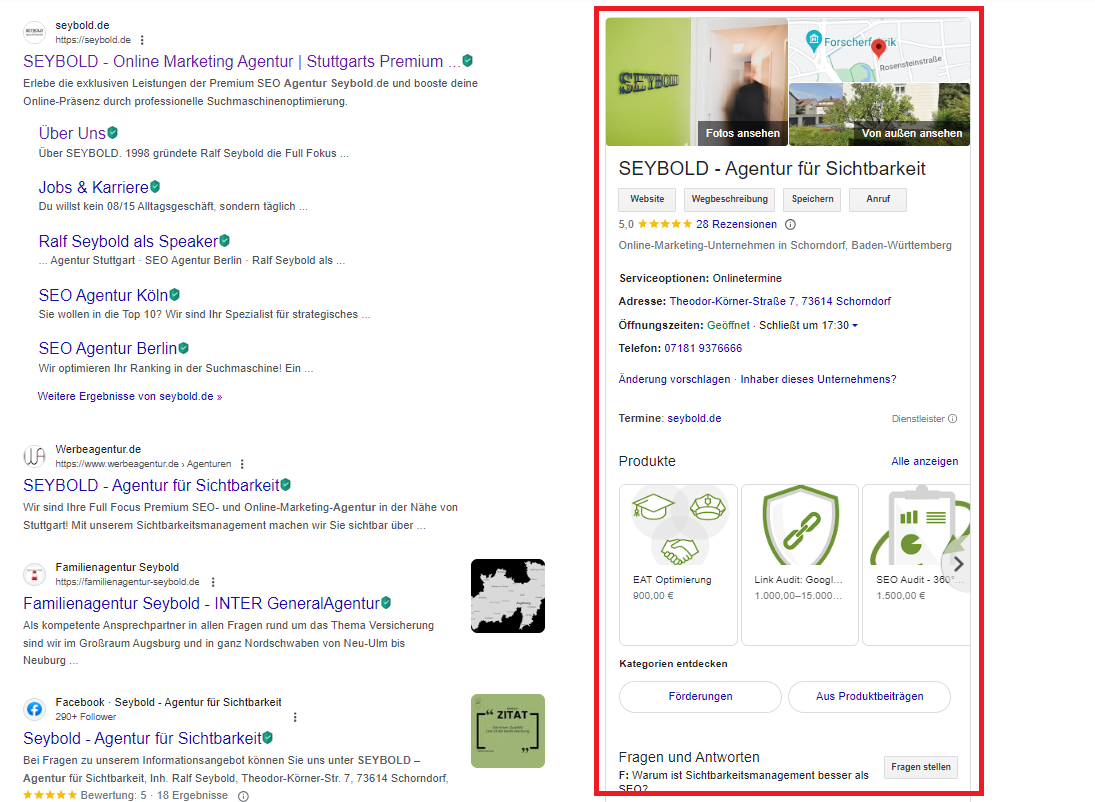
To create a Business Profile, it's essential that your company has a physical location and offers personal services, such as a café.
Additionally, Google Business Profile provides valuable insights into customer behavior. Businesses can see how often their profile is viewed, where users come from, and even what actions they take on the profile page. This information is extremely valuable for measuring online presence effectiveness and making adjustments.
Information Architecture
Information architecture makes it easier for users to quickly and easily find desired information through meaningful structuring. By using menus, categories, and click paths, users are facilitated in interacting with the website and accessing information. Therefore, information architecture is an essential building block of a website.
Content Marketing
Content marketing focuses on strategically creating valuable and relevant content. The goal is to attract and retain a precisely defined target audience and ultimately persuade them to take the desired action, known as conversion. For example, converting a visitor of an online shop into a buyer includes attracting users and links through compelling and high-quality content.
Mobile SEO
Mobile SEO is a specialized form of search engine optimization focused on mobile devices such as smartphones and tablets.
This significantly enhances the mobile user experience. Mobile site optimization has been an official ranking factor for years. Optimizing your website for mobile devices is sensible if you want it to be better found by mobile users.
SEO KPIs
SEO KPI, short for Key Performance Indicators, denotes relevant metrics used to measure SEO success.
Business processes can be analyzed and controlled using metrics. Numerical evaluations can, for example, identify trends.
Successes and failures are also displayed. Another advantage of KPIs is that they indicate areas where potential for optimization exists. Two examples of this are Organic Traffic and Average Session Duration. Organic Traffic measures the number of visitors who arrive at your website via Google search results. Average session duration refers to the time between page view and website exit.
Trends
For Google Discover optimization, trends should be observed.
Possible examples include Core Web Vitals, strategic link building, mobile websites, or artificial intelligence. These represent all the SEO trends of recent years. However, existing factors such as user intention and behavior, focusing on strategy and topics, should not be overlooked.
Black Hat SEO
Black Hat SEO refers to an approach to search engine optimization that deliberately violates Google's guidelines for ranking improvement.
What falls under Black Hat SEO?
- Placing backlinks on someone else's site (-->hacking) Not only violates Google Webmaster Guidelines but is also considered a criminal offense.
- Placing content on your own website that steals passwords.
- Placing trojans or other viruses.
The ability to buy backlinks is one reason why Black Hat SEO is practiced, as it's seen as easier than putting effort into a marketing strategy or SEO measures.
Due to Google's Penguin Update, which detects and ignores purchased backlinks, they no longer benefit the buyer or add value.