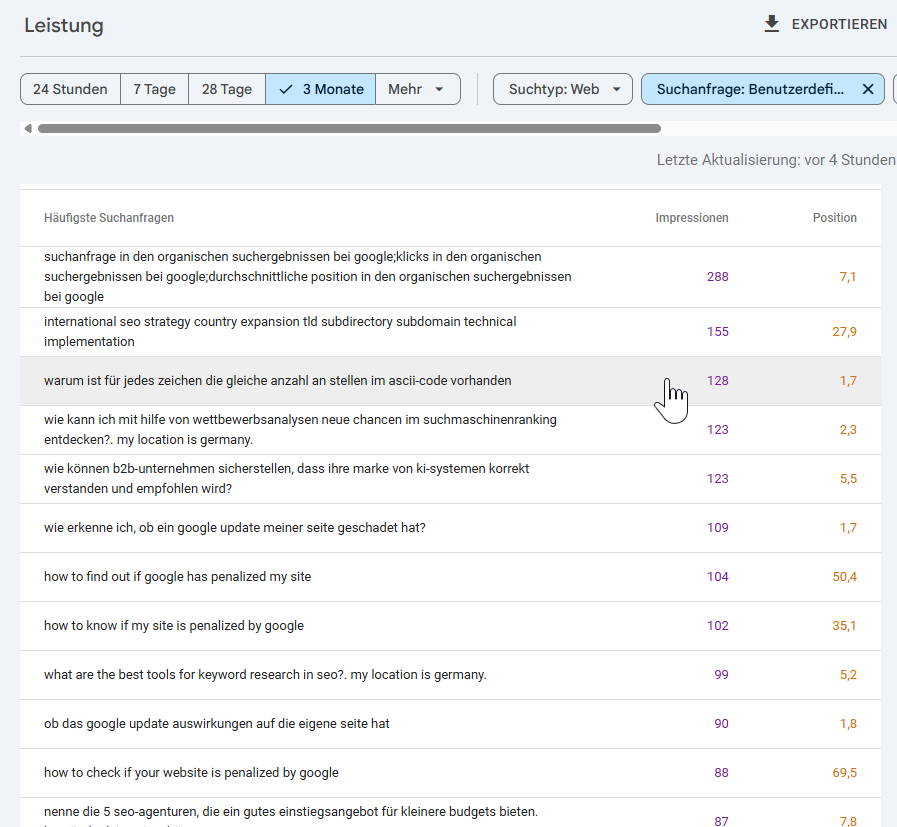
Prompt Tracking with Google Search Console
Prompt tracking is currently a black box.
OpenAI and other providers do not (yet) offer a transparent interface to analyze:
“What prompts are users actually entering about our brand?”
However, if you want to manage AI visibility strategically, you need exactly this information.
The practical solution:
Google Search Console (GSC) can serve as a proxy window — not perfect, but highly valuable.
Why GSC can be a useful proxy
There are indications that at least parts of LLM or AI-mode queries appear in Google Search Console.
There is no definitive proof. However, the following can be observed:
- Search queries are becoming significantly longer
- Wording is becoming more conversational
- Queries increasingly resemble spoken prompts
This is where structured analysis comes in.
Goal: Isolate prompt-like search queries
Instead of speculating, systematically filter for long, natural-language queries.
Rule:
Search queries with 10 or more words often behave like prompts.
Step-by-step guide in Google Search Console
- Open “Performance”
- Switch to the “Queries” tab
- Click “Add filter” → “Query”
- Select “Custom (regex)”
- Insert the following regex: ^(?:\S+\s+){9,}\S+$
What does this filter do?
The regular expression:
- counts the number of words in a query
- shows only queries with at least 10 words
- isolates typical conversational phrasing
Example structures:
- “What alternatives are there to [brand] for small businesses?”
- “Is [product] suitable for beginners or only for professionals?”
- “Experiences with [brand] compared to …”
Such queries provide far stronger intent signals than classic short-head keywords.
Important context
- This is not proof that these queries originate directly from ChatGPT or AI Mode
- It may also reflect changing user search behavior
- Pay attention to data privacy: do not export or share personal data
The goal is not absolute certainty, but strategic pattern recognition.
How to analyze the data in a structured way
1. Define the time range
Recommendation: last 3–6 months
2. Sort by:
- Impressions
- Clicks
3. Structure the data
- Label brand vs. non-brand
- Segment by:
- Pages
- Devices
- Countries
4. Export (CSV)
This is where the real work begins: clustering and intent classification.
How to use the insights strategically
1. Build topic and intent clusters
- Which questions repeat?
- What patterns emerge?
2. Identify content gaps
Are you missing:
- FAQ pages?
- How-to guides?
- Comparison pages?
- Use-case articles?
Long queries often reveal unaddressed micro-intents.
3. Optimize existing pages
Align your content with:
- natural, conversational language
- direct answers to specific questions
- active handling of objections
Less keyword focus — more prompt logic.
4. Inform stakeholders
These insights are valuable for:
- Sales
- Product development
- Positioning
- Messaging
You uncover recurring concerns, objections, and decision factors.
5. Build the foundation for AI visibility
The identified queries can be used as:
- input for prompt lists
- training data for AI monitoring
- a basis for structured prompt tracking
Optional: LLM analysis after export
After exporting the CSV, you can run an LLM analysis to understand:
- What questions users are asking about your brand
- Which attributes and objections dominate
- What linguistic patterns emerge
- Which intents are informational vs. transactional
This creates a data-driven insight layer instead of relying on intuition.
Why you will never find “the one prompt”
A study by Rand Fishkin showed that among 142 participants, prompt similarity for the same task was only 0.081.
The takeaway:
- Prompts vary significantly
- Standard phrasing does not exist
- Clustering is more important than individual examples
You will never know exactly how each user phrases a query.
But you can identify patterns — and act on them strategically.
3 key takeaways
1. GSC does not replace real AI log files — but it is currently the most powerful freely available window into potential LLM thinking patterns.
2. Long queries (10+ words) are a massively underestimated insight lever.
3. Those who analyze systematically early on gain a competitive advantage once AI-mode data becomes more widely available.
Prompt tracking is not yet a fully transparent process.
But with the right filtering strategy, it is no longer a complete black box.