How E-E-A-T and AI Change Link Building
How Link Building Strategies are Evolving with E-E-A-T and AI
Link building has always been a core component of search engine optimization (SEO). However, with the increasing importance of E-E-A-T (Experience, Expertise, Authoritativeness, Trustworthiness) and the influence of Artificial Intelligence (AI), the landscape has fundamentally shifted. In the past, securing a strong article from a trusted site was sufficient, but today that is no longer enough. It is more crucial to position yourself within the “E-E-A-T” framework and identify the sites that AI leverages to produce rankings.
We need fresh ideas and must re-examine and modernize traditional link building. Optimization is no longer solely for Google, and Google's share as a linking site has now dropped to only 63%.
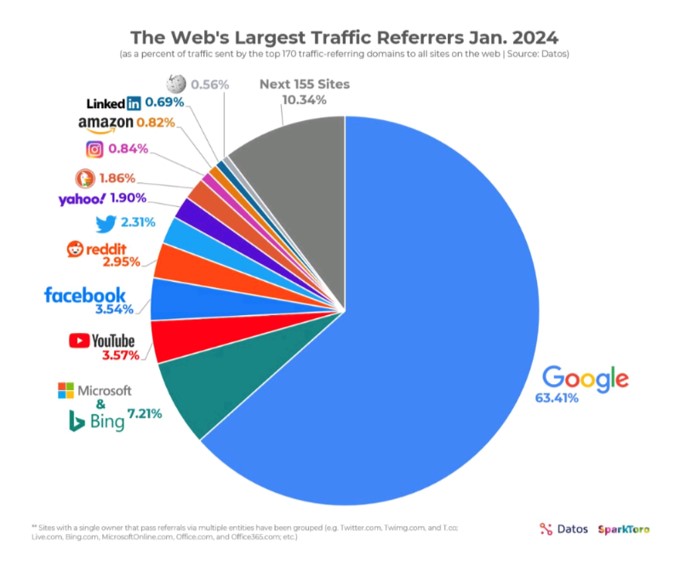
Platforms like Reddit, Facebook, LinkedIn, and others are becoming increasingly influential when it comes to linking to websites or showcasing content.
Additionally, efforts are being made to use artificial intelligence to present reliable information.
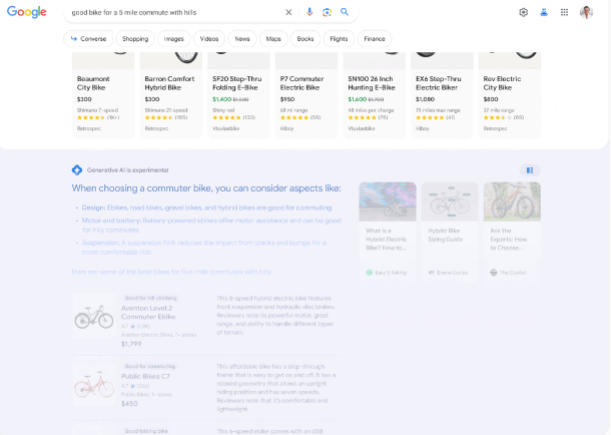
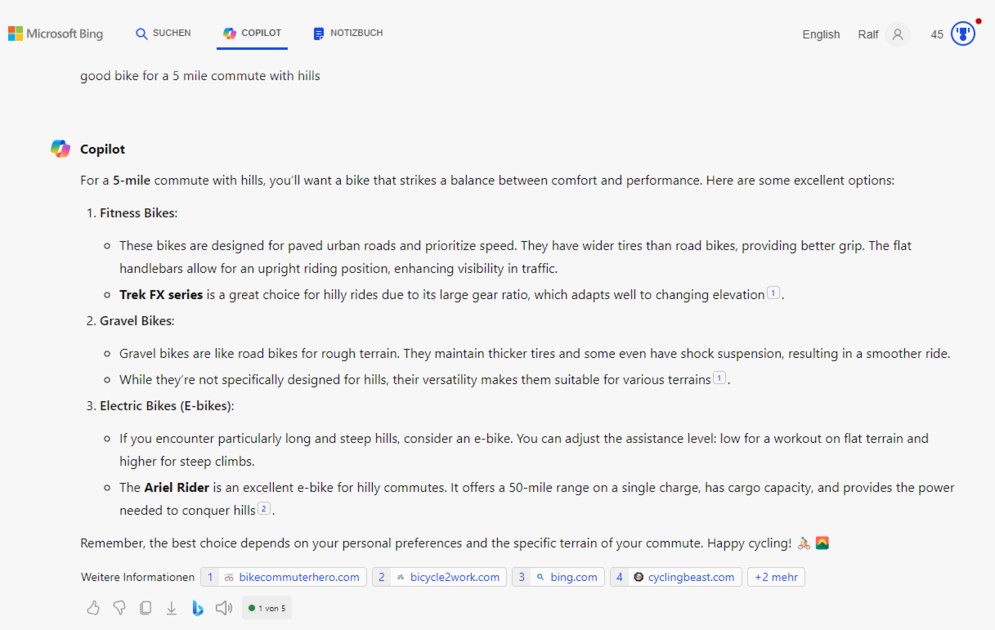
Wir bewegen uns also in der Komplexität der Suchmaschinenoptimierung in einem Bereich, bei dem es nicht mehr nur darauf ankommt, eine Seite in Google zu platzieren. Vielmehr kommt es darauf an, die Seite so aufzubereiten, dass die KI als Ergebnis einer Suchanfrage eigentlich die jeweilige Unternehmensseite, das Produkt oder das Unternehmen empfehlen muss.
Das Schöne daran: Die Älteren unter uns Marketeers erinnern sich noch, wie man 1998 optimieren musste.
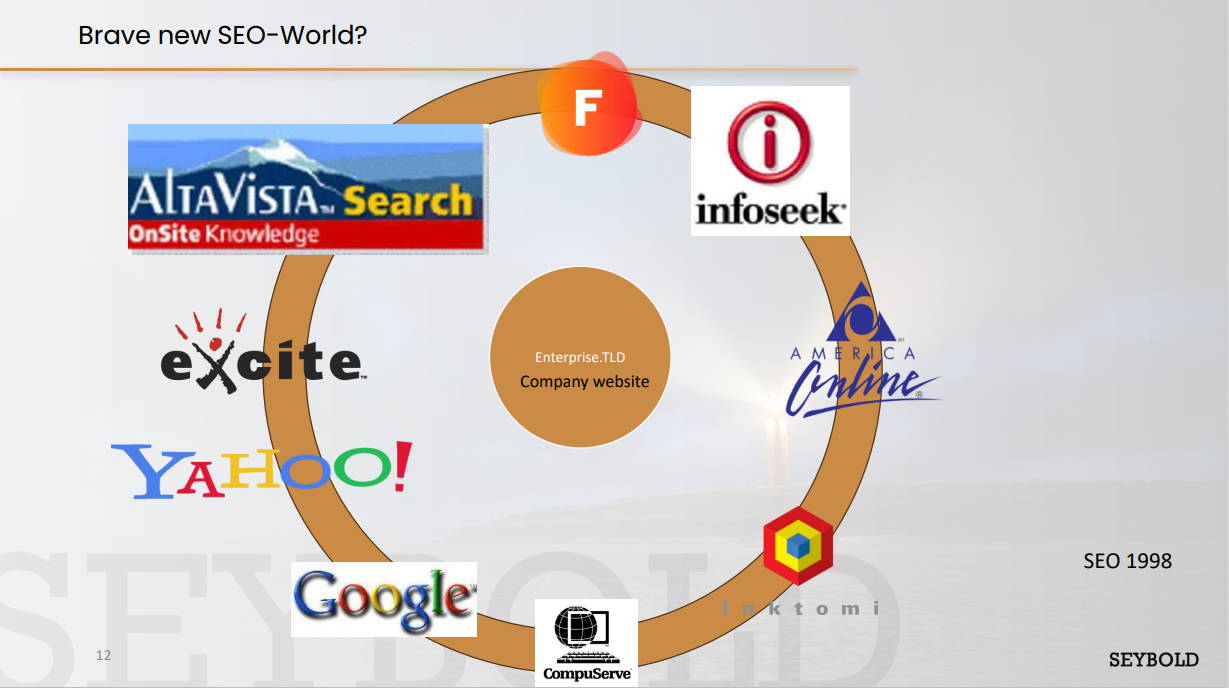
It's getting serious for all the lazy SEO experts out there. We can't just rely on Google; we need to think outside the box.
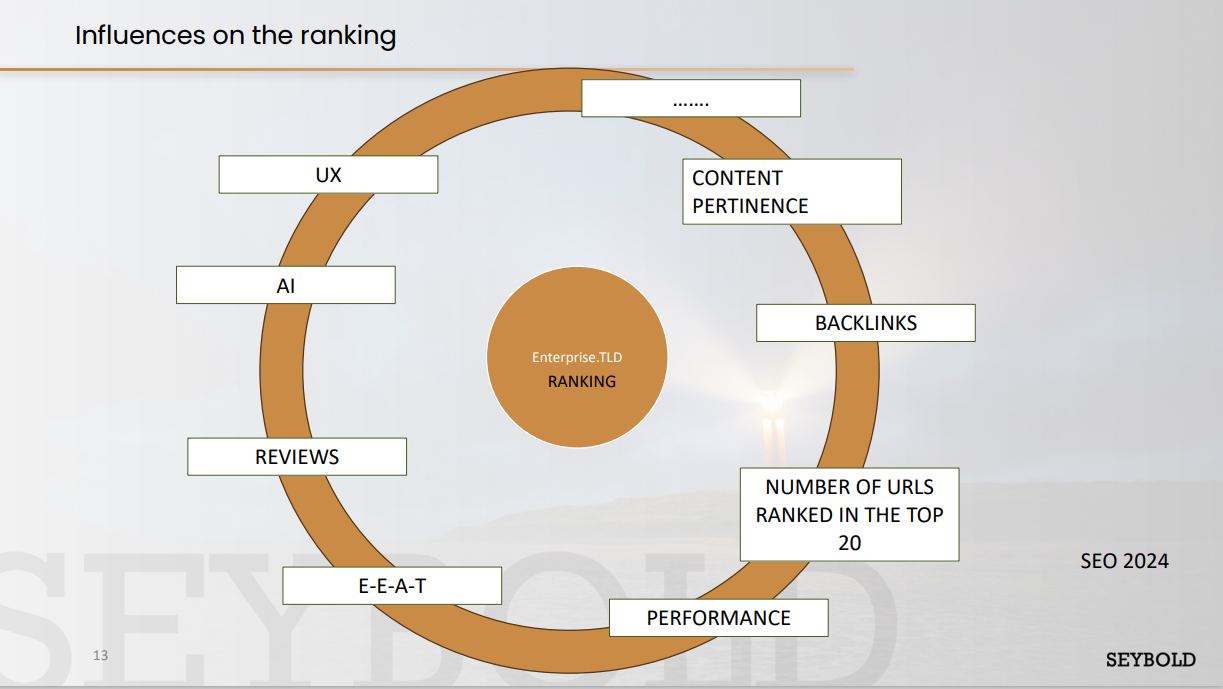
The good news: Some things remain the same. Certain aspects still need to be considered.
Still important:
- Content: The availability of relevant content and solutions remains a fundamental requirement
- Technical SEO: Technical SEO & information architecture make content discoverable and optimize performance
- Popularity: Links help Google assess the relevance of the content
New additions include user signals such as UX and E-E-A-T
- E-E-A-T: E-E-A-T is a search filter used by Google to evaluate the quality of a web presence
- UX: The user experience determines performance within and retention in the Top 10
What is E-E-A-T?
Definition and Importance
E-E-A-T is a concept by Google that evaluates the quality of a website based on the Experience, Expertise, Authoritativeness, and Trustworthiness of its content and authors. E-E-A-T is Google's quality concept, integrating elements from off-page evaluation methods (e.g., PageRank), on-page content evaluation methods (e.g., Panda), and entity evaluation (authors and organizations).
Until December 2022, E-E-A-T was known as E-A-T.
We recommend exploring more about EAT in our blog
- SEO Knowledge – E-E-A-T
- Google E-E-A-T and Y-M-Y-L
- Understanding and Utilizing E-E-A-T Link Building
The Four Components of E-E-A-T
- Experience: The quality of the content.
- Expertise: The knowledge and experience of the author.
- Authoritativeness: The recognition and acknowledgment of the author.
- Trustworthiness: The credibility of the content and the author.
What Characteristics Are Part of E-E-A-T?
- Are authors specified for expert articles?
And: Are they specialists or has an expert review been conducted? - Is the publication/update date provided?
Are all contents current, indicating they are up-to-date with the latest expertise? - Are sources and additional links provided?
- Are there positive reviews and ratings? Are these integrated into the site?
- Are certifications, such as DIN, present and integrated into the website?
- Are there backlinks from high-authority domains?
What Characteristics Generate E-E-A-T – Trust?
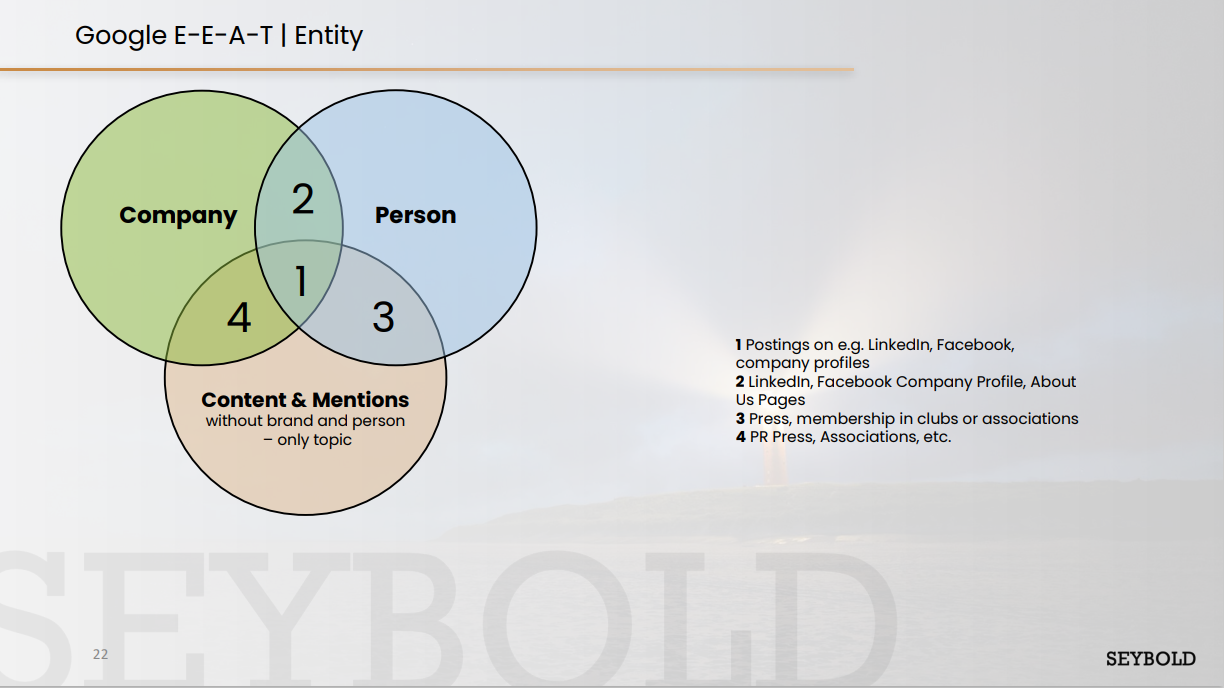
Companies generate entity through
- Website
- Business directories
- GMB
- Social media channels
Content and mentions that create entity through:
- Press releases that mention or link to persons or products of the website.
- Reports that indirectly confirm the company's product or website topic.
Individuals generate entity through:
- Listings on Xing, LinkedIn, Facebook (allowing the person to reference)
- Wikipedia entry
- Google Scholar
- Personal website or branding pages such as Pinterest, etc.
- Google Knowledge
Linkbuilding mit E-E-A-T
Traditionelles Linkbuilding vs. E-E-A-T Linkbuilding
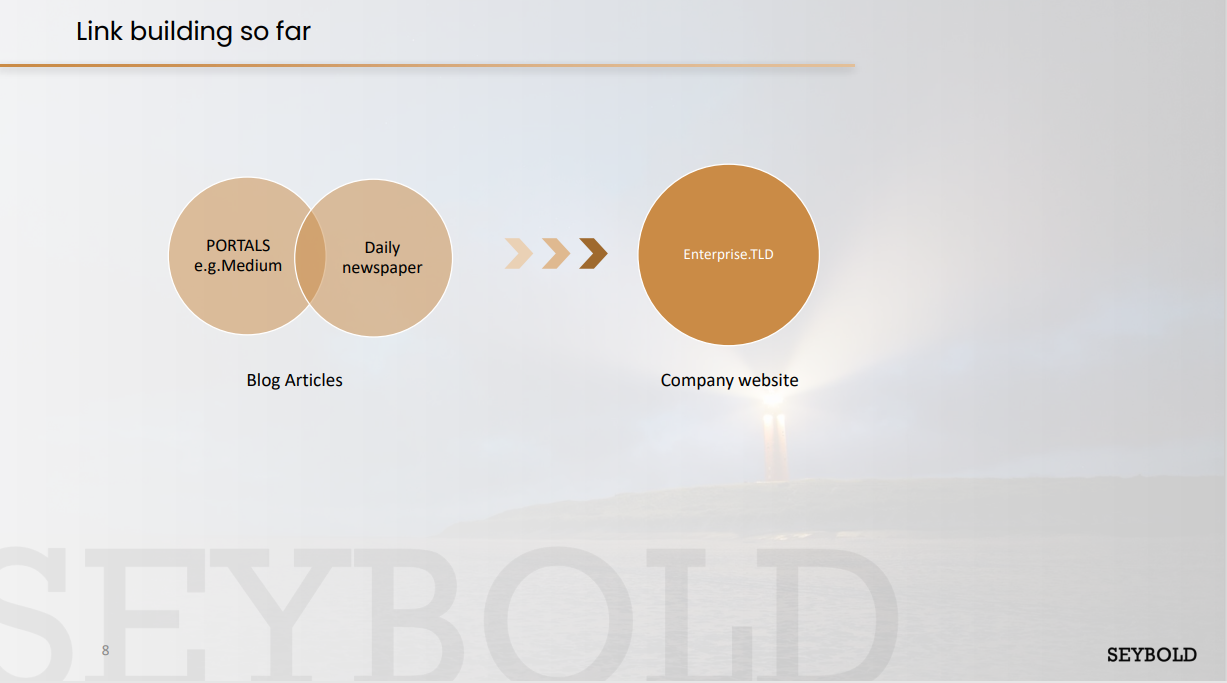
Traditionelles Linkbuilding konzentrierte sich hauptsächlich auf die Anzahl und Qualität der Backlinks. Mit E-E-A-T rückt die Qualität und Relevanz der verlinkenden Seiten sowie die Autorität der Autoren stärker in den Fokus.
Practical Approaches and Examples
- Linking to high-quality and trustworthy sites
- Incorporating expert contributions
- Utilizing industry directories and portals such as Medium or Google Scholar
The Role of Artificial Intelligence (AI) in Modern Link Building
AI-driven SERPs (Search Engine Results Pages)
AI is changing how search results are presented and evaluated, including the weighting and evaluation of backlinks.
The Mechanics of E-E-A-T and AI
Google uses patents like Agent Rank and Speaker Identification to recognize and assess the identity and expertise of authors.
How Google patents can help explain the functioning of E-E-A-T
- Agent Rank – Patent filed by Google in 2007
- This patent helps improve the ranking of pages based on the identity of authors or publishers.
Google finds out if a site mistakenly used an expert's name as the author of an article they didn't write.
- Speaker Identification – Patent filed by Google in 2020
- Identifying speakers using speech recognition
- Often applied in places like YouTube
Google aims to index actual speakers and authors and websites based on the characteristics that make them unique.
Google identifies entities included in a Knowledge Graph
- Since 2018, Google has been working with the US Census, World Bank, and other data sources in an open database called Data Commons.
- Google will use natural language processing to better understand user intent and assign queries to relevant sources in Data Commons.
- Google knows entities by demographic characteristics
A: Website Representation Vectors – Patent filed on August 1, 2018
- Patent can determine if a person or brand is a genuine expert in their respective field.
- Google is able to classify websites into different expertise categories like expert, apprentice, and layman.
- Analyze the text or images on the website.
- Consider other website content (e.g., links).
- A combination of two or more of the above.
B: Obtaining Authoritative Search Results – Patent granted by Google in 2017.
- Google can distinguish websites that are of low quality due to shallow content or excessive advertising.
- Also, with this patent, Google works to identify authors.
- Google recognizes website relevance.
Website Representation Vectors
- This patent determines which content is considered YMYL (Your Money, Your Life).
- Google uses neural networks to understand patterns and features behind websites.
- Especially to classify websites in categories like health, medicine, finance, and more.
- No patent to question if Google EEAT measures author, site, domain, or brand level.
- However, there are guidelines for search quality for the main content creator and the main content itself as well as the website.
- Google revised its quality guidelines in 2019 to expand the YMYL term from page-level considerations to "topics".
Google Products and Their Impact on E-E-A-T
Key Google Products
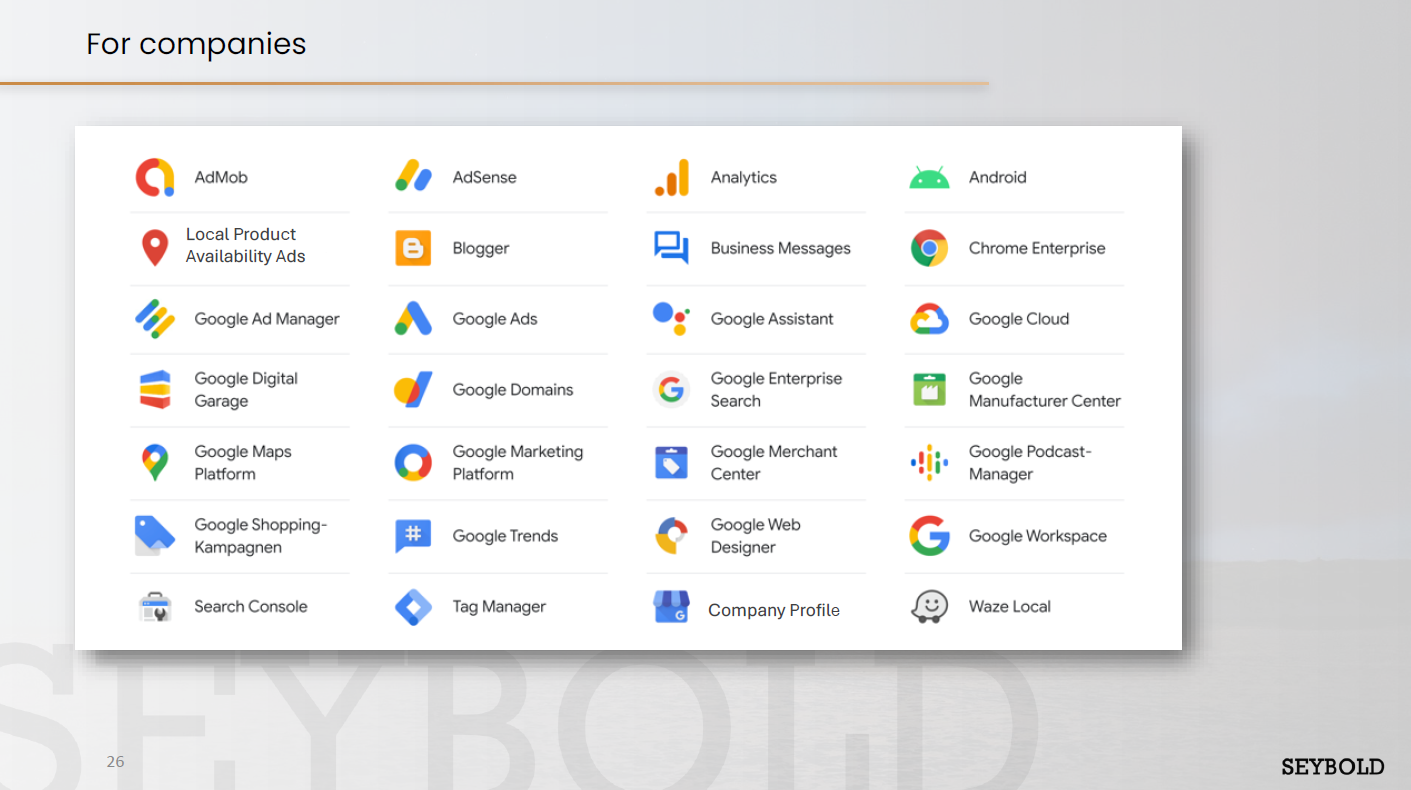
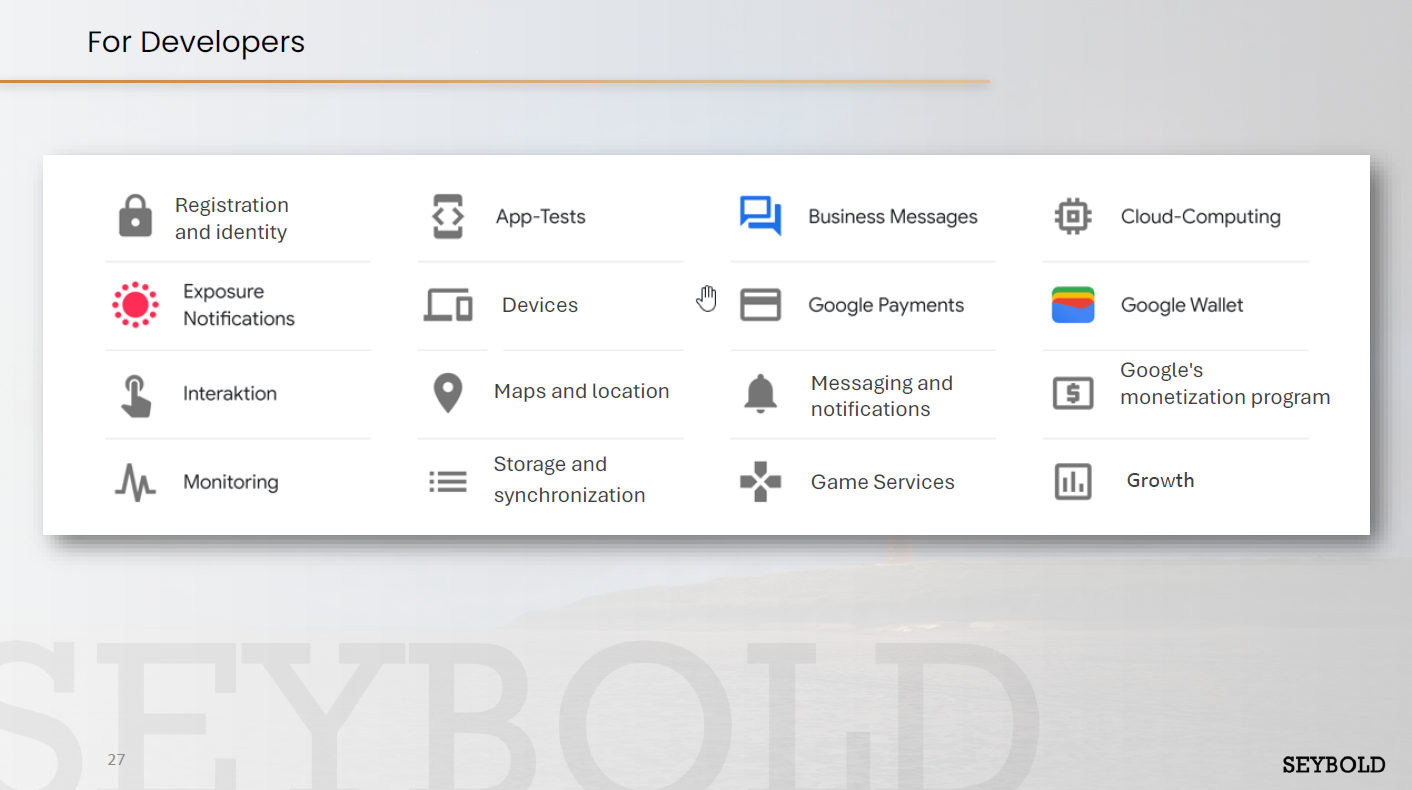
Products like Google My Business, Google Scholar, and the Google Knowledge Graph play a crucial role in evaluating E-E-A-T.
Numerous products are offered by Google. In each of these products, it is possible to build a corresponding trust. As a result, this should be used.
E-A-T through Google Products
Google Products
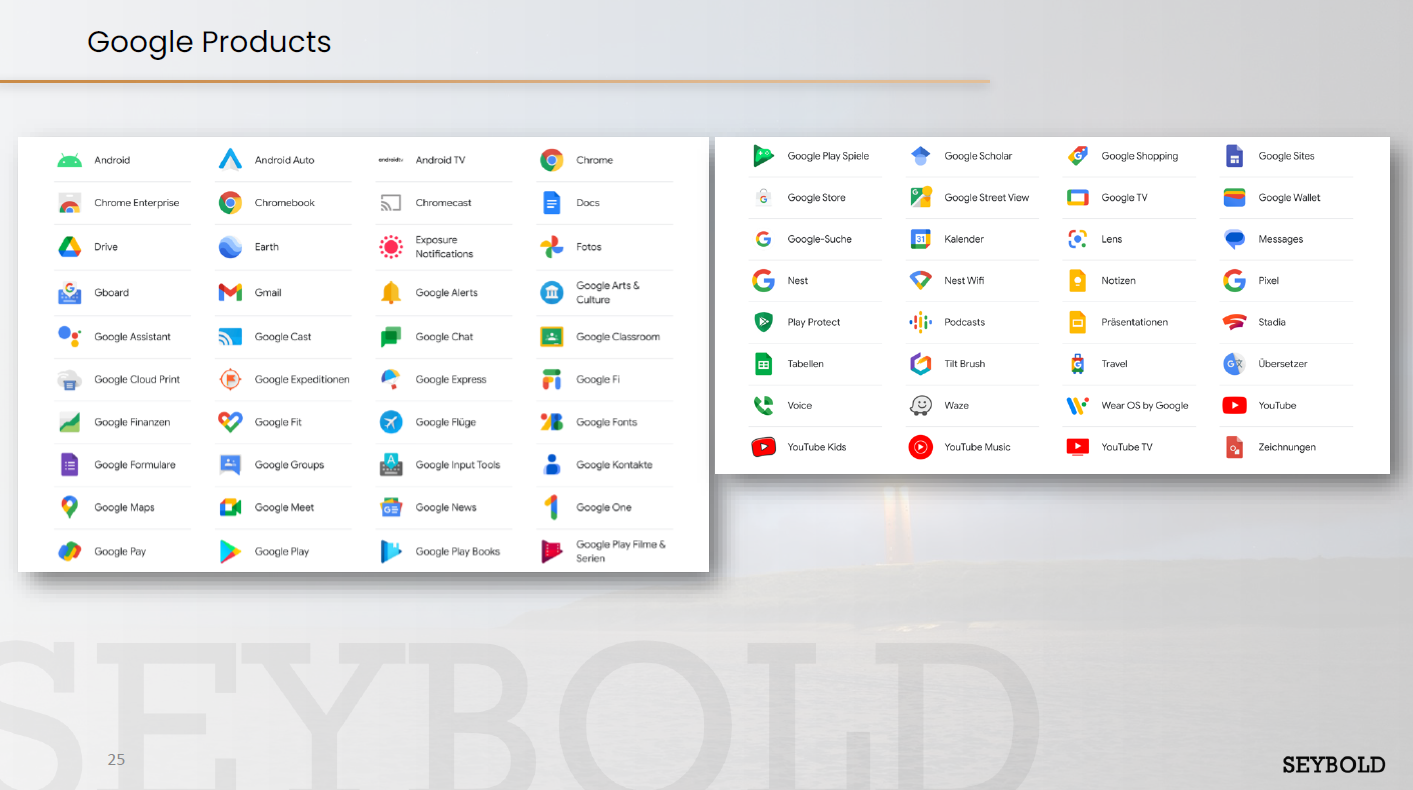
For Business
For Developers
Integration and Utilization for Enhanced Link Building
- Utilization of Google products to increase authority and visibility
- Integration of Google Jobs, Google News, and other relevant products
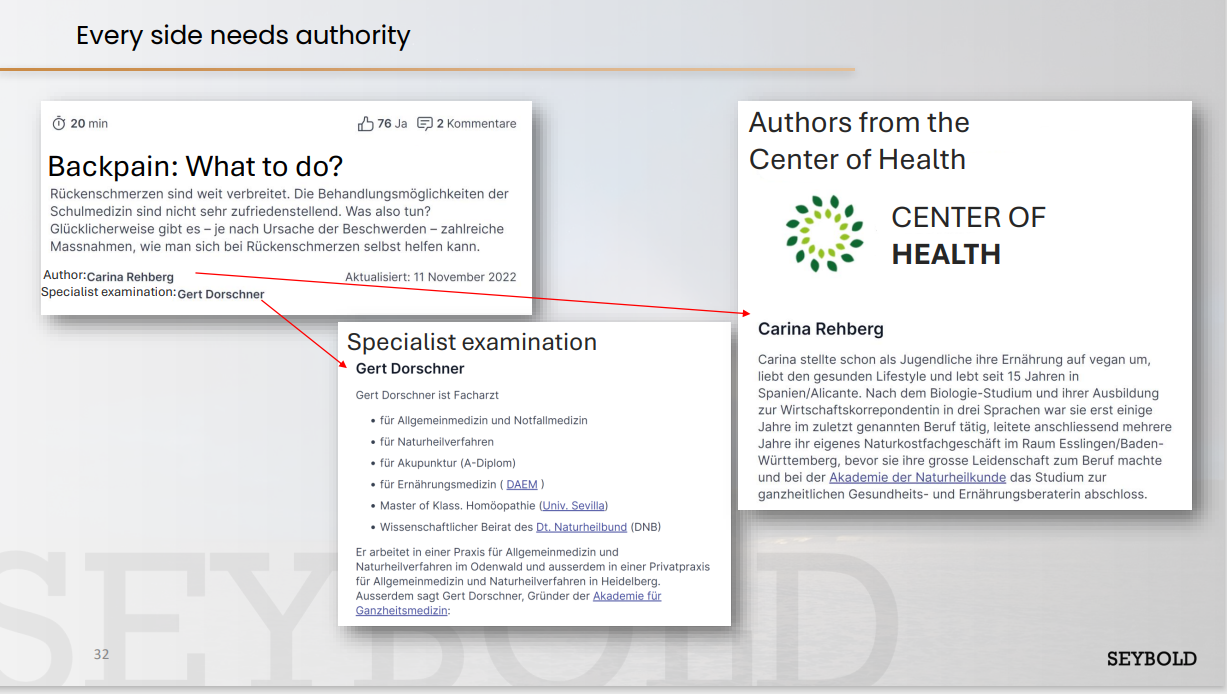
It's important to highlight and present the respective expertise in articles. Trust can only be built through referencing this information. Perhaps this is the opportunity to showcase competencies seemingly without backlinks.
Excursus: The three dots in search results
During the beta phase, we examined the "three dots" in search results. At the time of the beta, there was a lot of information that is no longer available today.
In this research, we:
- Analyzed the top 10 in various industries
- Germany and USA
- Used different search terms (money keywords)
- Expanded search terms as necessary
- Analyzed peculiarities
- Checked backlinks
- Evaluated "first indexed on" dates
- Reviewed reviews
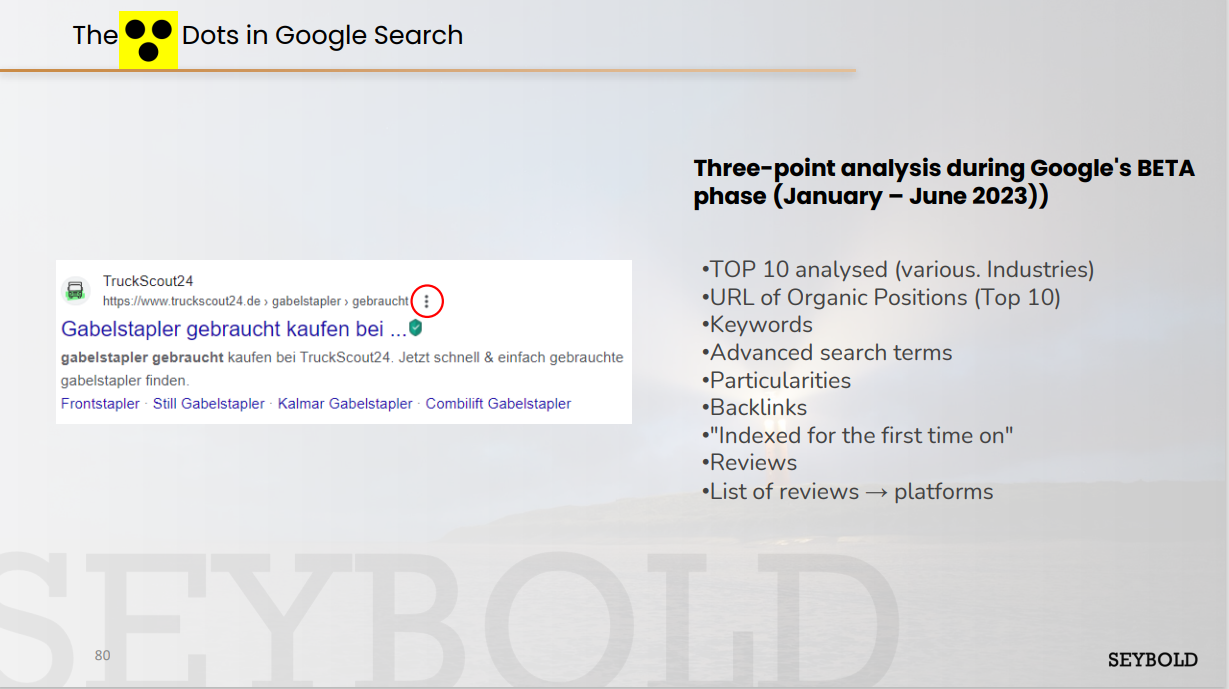
As a result, there is exciting information on "must-have" entries that Google apparently uses for evaluation.
| Topic | Relevant Platform |
| Social "Company Entries" | In Germany, more XING than LinkedIn |
| Commercial Register | Northdata, Creditreform |
| Review Platforms | Golocal, Provenexpert, Feedbax, Trustpilot, Trustami, Trusted Shops |
| Company Size | Kununu, Stepstone, Indeed |
| Encyclopedias/Wikis | Wikipedia, Press Portals, Newspapers |
| Jobs | Stepstone, Indeed |
| Portals | Agenturtipp (with reviews) for German SEO agencies, business directories, europages.de, unternehmen24.info |
The most important review platforms based on our research are:
- bewertet.de
- Golocal
- Kununu
- (Trusted Shops)
- (Amazon Customer Reviews)
- (TripAdvisor)
- Yelp
- Google My Business
- Glassdoor
- Yably
- Trustami
- kennstdueinen.de
- agenturtipp.de
- Trustpilot
- ekomi.de
How does Google train its LLMs?
The basis for training artificial intelligences includes the following:
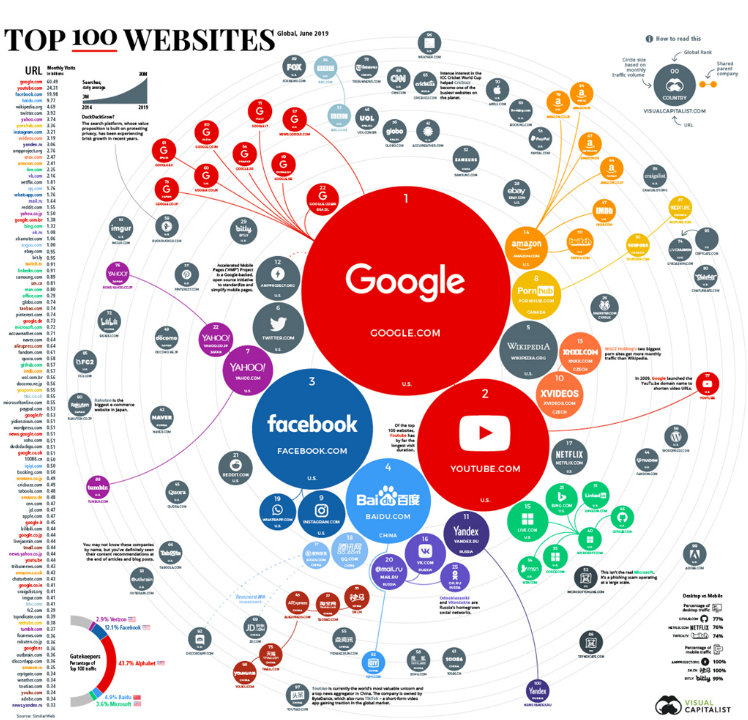
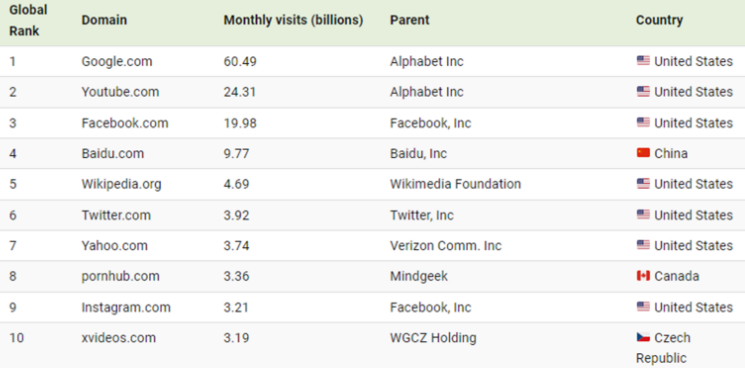
Google has released the C4 dataset, which was used to train the AI.
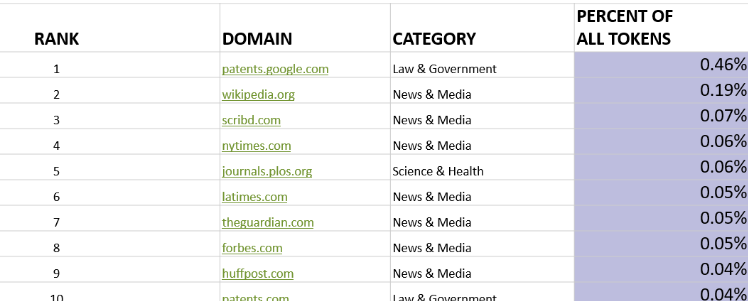
For each respective area, there are corresponding strong pages that are considered. Important backlinks for News & Media websites are therefore:
- wikipedia.org
- scribd.com
- nytimes.com
- latimes.com
- theguardian.com
Further examples can be found in the handout of my presentation at Campixx 2024, which is available for download below.
Best Practices and Recommendations
So what does this mean for the company? Primarily, it is necessary to build authority and trust in your own brand, your own company.
There are several ways to achieve this:
Building Authority and Trust
- Building expert profiles on platforms such as LinkedIn and Google Scholar
- Creating a central author profile that is appropriately linked
- Publishing professional articles and studies
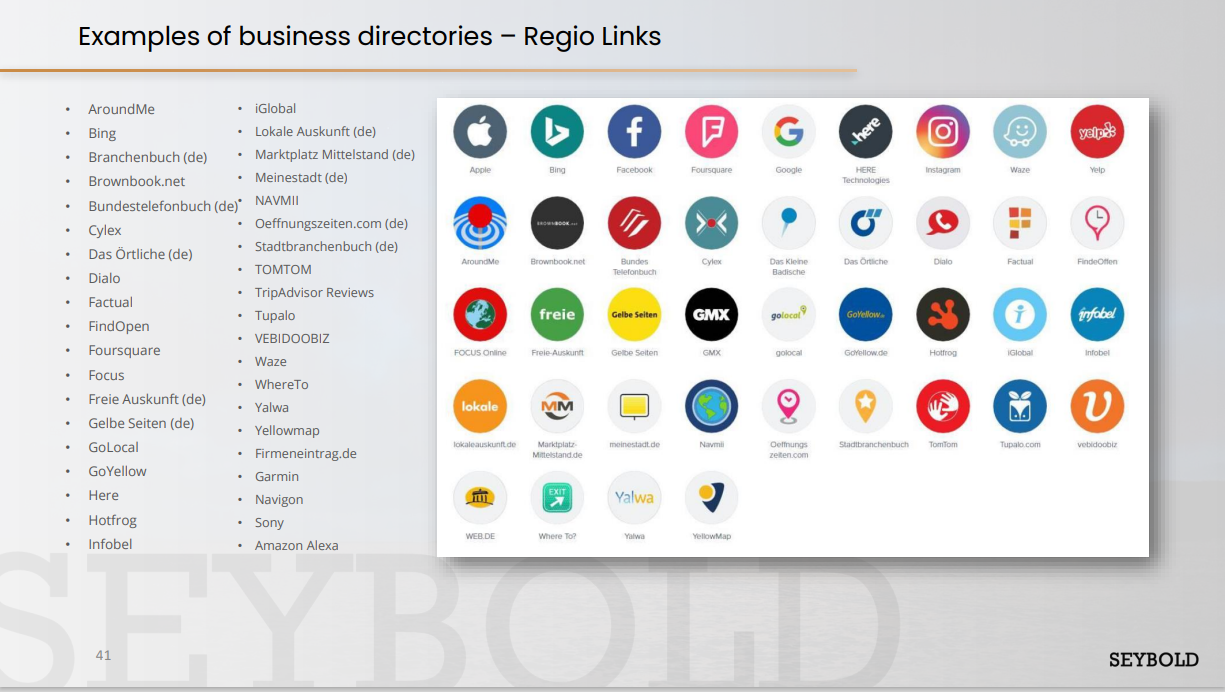
Utilizing Industry Directories
Entries in relevant industry directories are an important component for the entity of the company.
This includes the following directories:
Utilization of Niche-Relevant Portals
Utilizing specialized niche portals to enhance relevance and authority is a popular way to increase benefits for artificial intelligence as well.
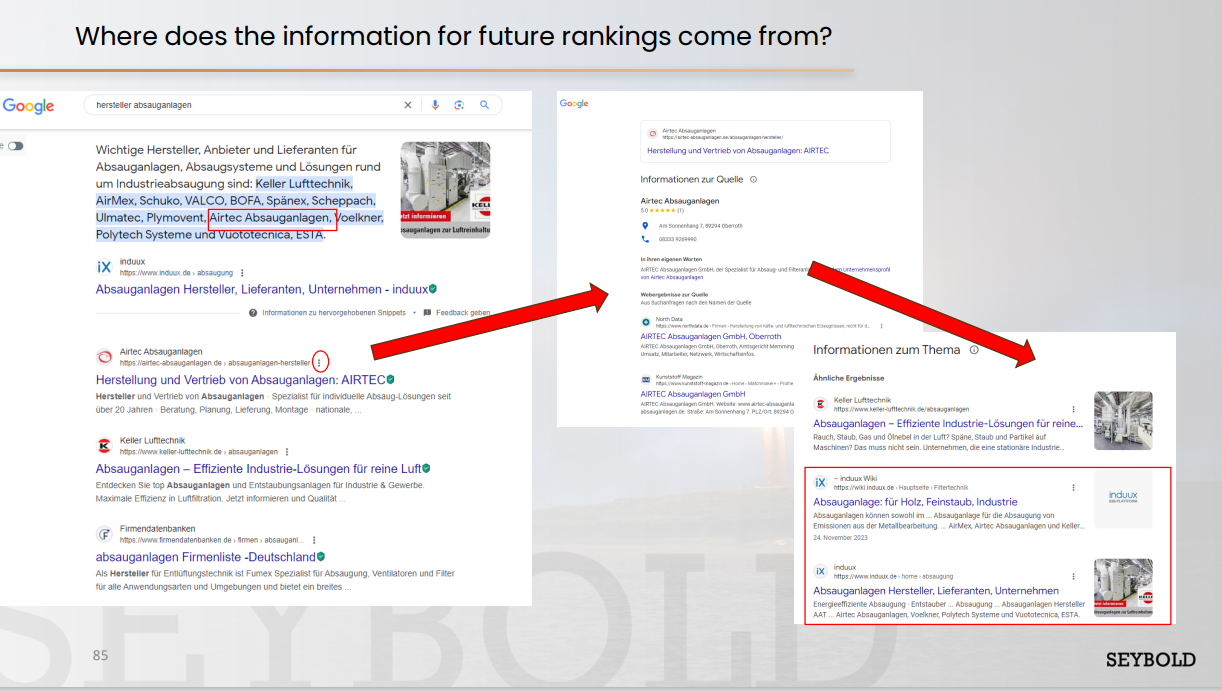
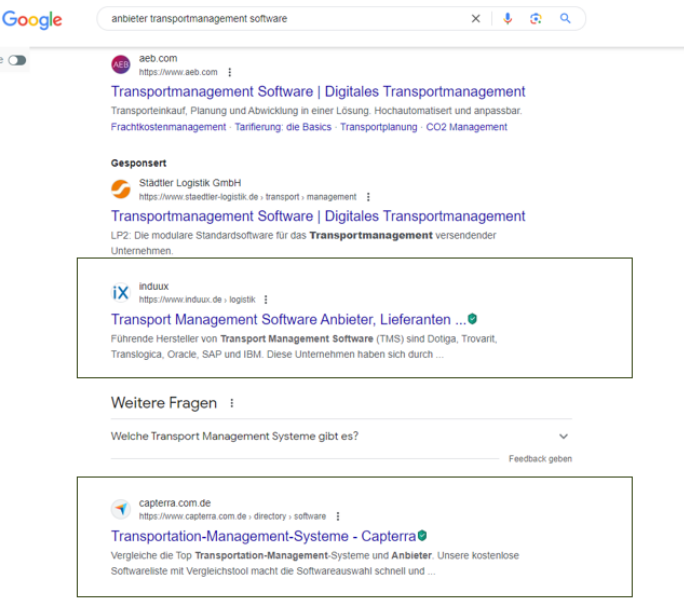
The example of the niche portal induux.de demonstrates the benefits that arise from this.
1. Position 0 and Improved Rankings
Portals often achieve featured snippets. Furthermore, relevant content ensures that the website's own position also improves as a result.
2. Competitive displacement
Achieving a top position for your company's website also opens up opportunities to displace competitors.
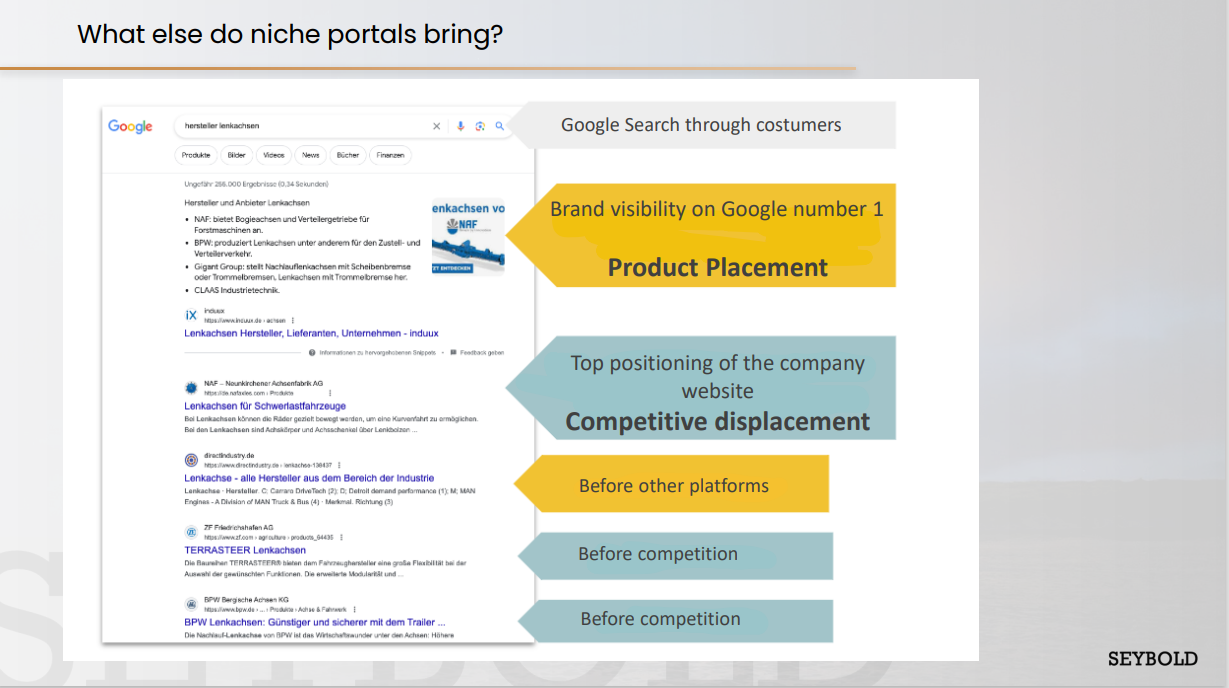
3. Niche relevance often even surpasses significantly more well-known platforms
Significantly better positions than competitors on specific topics are also conceivable and are often achieved.
Link Building Using AI and E-E-A-T
Integrating E-E-A-T and Artificial Intelligence into link building strategies is essential for long-term success in search engines. High-quality and relevant content remains the focus.
What is changing, however, is how links are directed to respective articles.
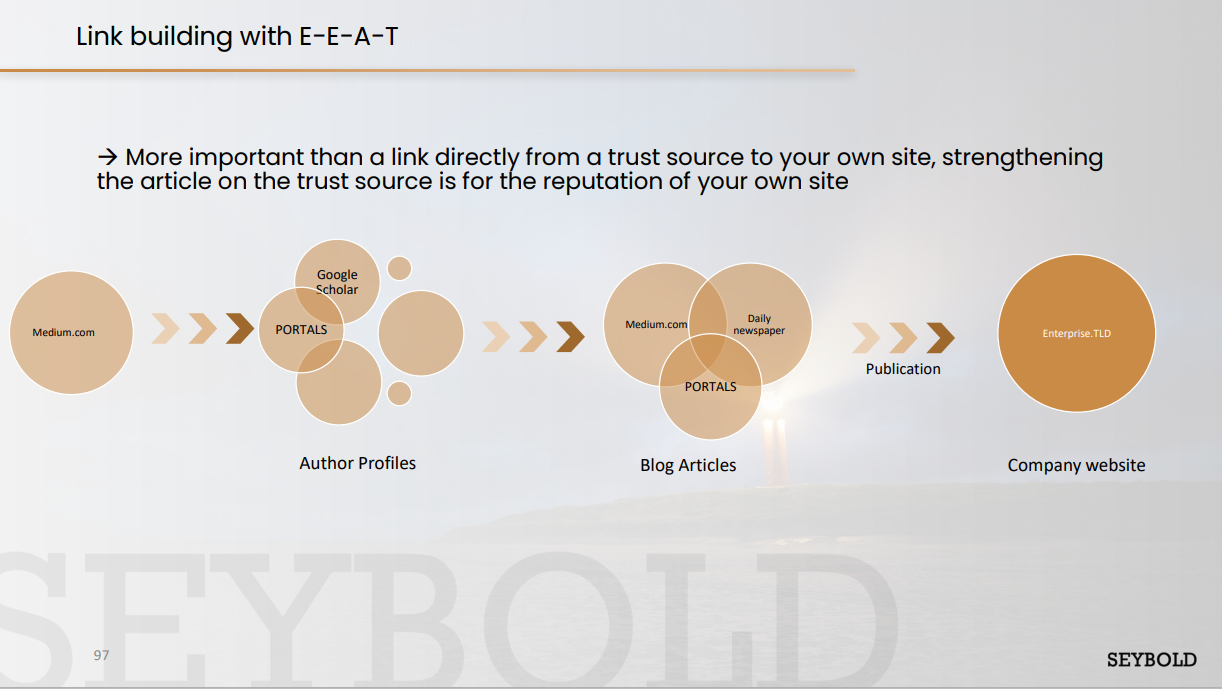
Strengthening portals and author profiles has become significantly more important than directly linking from a blog article to the company's website.
Building strong profiles and niche sites will form the foundation for rankings in the coming years, without which achieving decent positions will be difficult.
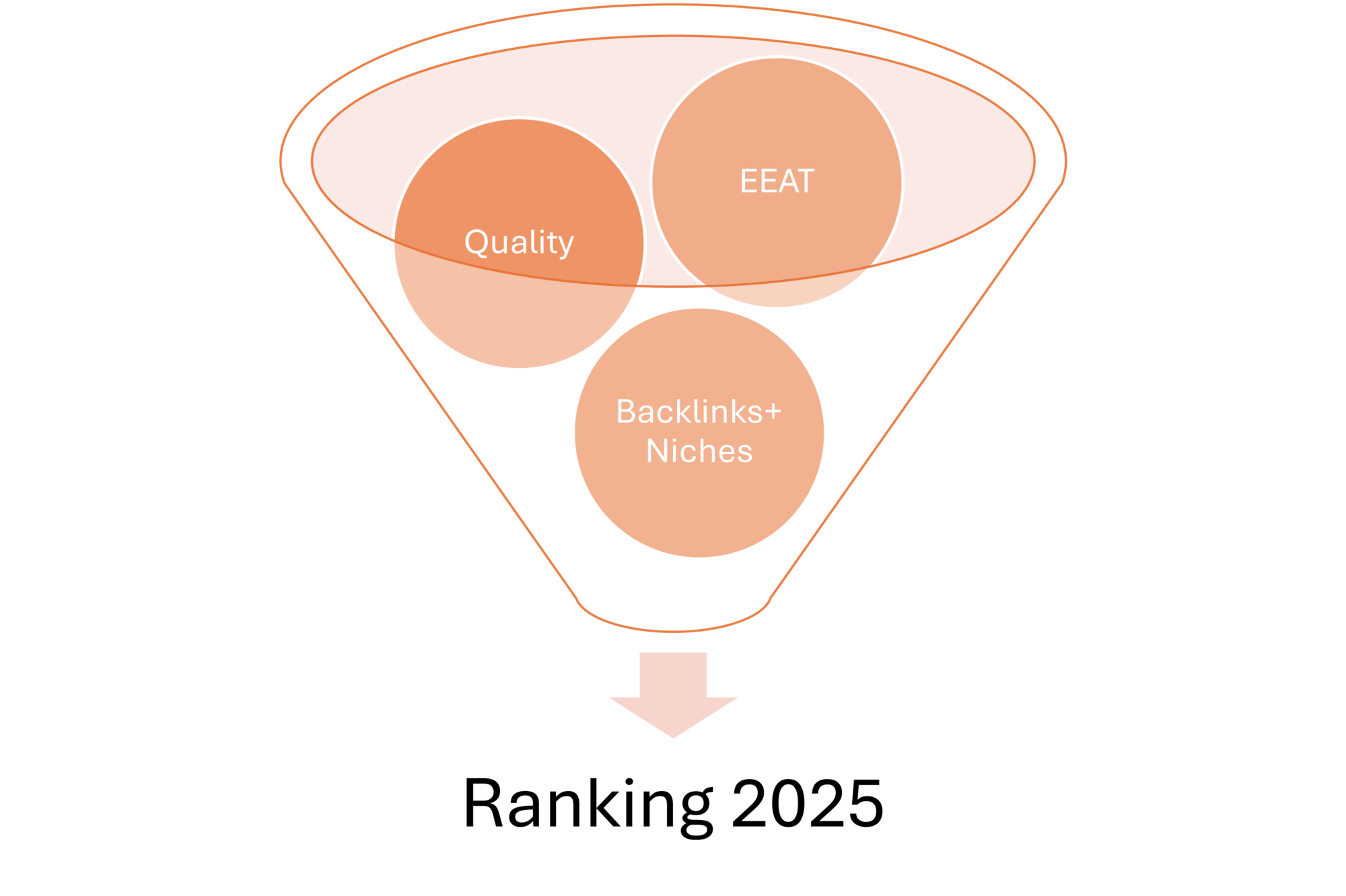
By focusing on high-quality, relevant content and utilizing AI tools, businesses can significantly strengthen their visibility and authority. The reasons for this are:
- Awareness of quality thanks to E-E-A-T
- E-E-A-T "can" evaluate quality without a direct link.
- Backlinks are no longer about power, but about trust and traffic.
- Prerequisite: Content that provides added value.
- Google will perceive the link designation as natural when the involved sites have high-quality, relevant, and useful content.
- The link helps strengthen the authority of ALL directly connected websites
⇒ Artificial intelligence uses this knowledge as a basis. - Building backlinks from/to trust sites with traffic and creating connections to author pages (which provide proof of E-E-A-T).
E-E-A-T and portals play a decisive role in the content of AI-operated search results.
The entire presentation with extended information, as given at Campixx 2024 on June 13, 2024, is linked for download here.
Further information:
https://www.heise.de/news/Blick-in-die-Blackbox-KI-Trainingsdatensatz-C4-schoepft-auch-aus-trueben-Quellen-8973782.html
https://paperswithcode.com/dataset/c4
https://www.washingtonpost.com/technology/interactive/2023/ai-chatbot-learning/