Link Audit: The Impact of Backlinks on Visibility
By the way: Ralf Seybold is a contributor to “The Art of SEO”, the global standard reference for SEO, and has contributed his specialized expertise and experience—particularly in the area of links and penalties (link penalties)—to the current edition.
Harmful Backlinks Identified – What to Do?
If you discover low-quality backlinks in your website’s backlink profile, they can be removed. One way to do this is by using the Disavow Tool, which allows you to request the permanent removal of specific links. However, this tool should be used with caution, as the links are permanently disregarded.
Another tool for removing harmful backlinks is Link Detox. This software, developed by LinkResearchTools GmbH, not only helps eliminate toxic links but also assists in distinguishing between good and bad backlinks.
When Should a Link Audit Be Conducted?
- Regular review: A link audit should be conducted at least once a year to ensure all links are up to date and functioning properly.
- After major website changes: If a website undergoes a redesign, restructuring, or domain change, a link audit is necessary to ensure all internal and external links are correctly updated.
- SEO issues: If the website suddenly experiences a drop in search engine rankings or organic visibility, a link audit can help identify harmful or unnatural links that may be causing the issue.
- Content updates: After major content updates or when new content is added, to ensure that all internal links are meaningful and helpful.
- After search engine penalties: If a website has received a penalty from Google or another search engine, a thorough link audit is required to identify and fix all problematic links.
- After backlink purchases or link-building campaigns: Following extensive link-building campaigns or purchased backlinks, an audit should be conducted to evaluate the quality and nature of the new links.
- User feedback: If users frequently report broken links or poor user experiences related to links, an audit is necessary to resolve these issues.
- Website owners and webmasters: To ensure their website is well-linked in order to achieve better search engine rankings and more organic traffic.
- SEO experts and agencies: To monitor and improve the link profiles of their clients’ websites and achieve better search engine rankings.
- Content marketing strategists: To understand which content generates the most backlinks and which strategies are most effective for acquiring links.
- Competitive analysis teams: To analyze competitors’ backlink profiles and understand which links help them achieve high search engine rankings.
- E-commerce businesses: To ensure their products and services are well-linked in order to increase traffic and sales.
- Bloggers and influencers: To increase their visibility and authority in their niche by gaining high-quality backlinks.
- Digital marketing managers: To optimize the overall digital marketing strategy by monitoring and adjusting the effectiveness of backlink campaigns.
- PR and outreach teams: To measure the success of their PR campaigns and identify which publications and content generate the most attention and backlinks.
- Business consultants: To provide clients with well-founded recommendations for improving their online presence and digital marketing.
- Startups and small businesses: To build a solid foundation for SEO and gain high-quality backlinks early on to support their growth.
Manual Execution of a Link Audit
A manual audit ensures the best possible evaluation of a website for our clients.
Backlink Analysis
Backlink analysis involves examining the links from external websites that point to your own website.
Through backlink analysis, website owners gain valuable insights into the quality and relevance of their backlinks. It’s not just about how many backlinks point to your site, but also about the quality of the linking websites. Not all backlinks are equal—one backlink from a high-quality, relevant website can be far more valuable than several from low-quality sites.
An important aspect of backlink analysis is evaluating anchor texts—the clickable text used in links. The anchor text should be relevant to the content of the linked page so that search engines recognize it as a high-quality backlink. Additionally, backlinks should be acquired naturally, not through manipulative practices such as buying or exchanging links. Search engines like Google can detect such manipulations and may penalize the affected website.
Another key factor is analyzing link sources. Backlinks should come from relevant and trustworthy websites. Links from spam sites or low-reputation domains can harm rather than help your website. Therefore, it is advisable to regularly review backlink sources and remove harmful links when necessary.
Backlink analysis can also help identify potential partners. By analyzing which websites already link to your site, you can find potential collaborators who have shown interest in your content. Strategic partnerships with such sources can lead to more high-quality backlinks and improved search rankings.
In addition to external backlinks, it is important to review your internal linking structure. A well-structured internal linking strategy helps search engines crawl and index your site more effectively. It also encourages users to stay longer and explore more pages, which can positively impact rankings.
Backlink analysis should be conducted regularly to ensure link quality remains high and to prevent penalties from harmful backlinks. It’s not only about reviewing existing links but also identifying new opportunities for high-quality link building. Continuous and natural link growth is essential for strong search engine rankings.
In summary, backlink analysis is a crucial part of search engine optimization. It provides valuable insights into the quality and relevance of backlinks and enables targeted improvements. Regular and thorough backlink analysis is essential for long-term success in search engine rankings.
How Does a Link Audit Work?
Identify Harmful Backlinks
If no manual actions are reported in Google Search Console, the first step is to collect all backlinks—meaning all backlinks. It is not sufficient to rely on a single backlink checker, as tools like Ahrefs and others may not provide the full set of backlink sources. Relying on just one source is therefore not enough.
Negative SEO
Unfortunately, competitors or other entities may create harmful links using manipulative anchor texts. This is especially common in highly competitive markets. A link audit allows you to analyze your backlink profile (as well as those of competitors) to quickly detect and contain negative SEO. In some cases, it is even possible to identify the source of such attacks.
Remove Harmful Backlinks
Once harmful backlinks have been identified, they need to be reviewed. During this process, a disavow list is created. In the next step, these links are declared invalid so that they no longer influence your rankings. The backlink profile is cleaned, allowing Google to evaluate a healthier link profile.
Disavow Links
To invalidate harmful links, you need to create a so-called disavow file. This file is uploaded via Google Search Console and tells Google which links should be ignored. However, mistakes in the disavow file can have serious consequences. For example, if the linking site switches from HTTP to HTTPS, it may be treated as a new link and no longer be disavowed—potentially harming your backlink profile again. Proper implementation is therefore critical.
Disavowing harmful links also signals to Google that your company is serious about maintaining a clean and trustworthy backlink profile.
For this reason, it is essential to set up link alerts and regularly monitor backlinks as part of link risk management to detect harmful links early.
The most accurate way to take a thorough look at backlinks is to review them manually.
This is why we proceed as follows:
What Happens After a Link Audit?
Once the link audit, including the upload of the disavow file, has been completed, Google needs to crawl the harmful links in order to reassess the website’s backlink profile. A Link Detox Boost is used for this purpose, enabling faster recovery.
Afterward, it is essential to continue building the backlink profile with new, high-quality links.
We have compiled 20 link-building ideas to help you find new link partners. Once these backlinks are established, it usually takes up to four months for them to take effect (“How fast do backlinks work”).
Searching for lost backlinks can also help identify valuable new link sources.
Keep in mind that link building is an ongoing process—not a one-time opportunity to optimize your backlink profile.
IMPORTANT
Link audits play a crucial role in maintaining long-term visibility and staying competitive. Since backlinks are considered one of the most important ranking factors, it is essential to regularly review them. Spam links or the loss of existing backlinks can quickly lead to a drop in website traffic.
To prevent this, it is advisable to continuously monitor your backlink profile and take action early. Regular link risk management can help avoid revenue losses and protect valuable jobs.
You can find results of successful backlink audits in our references.
Do you need a link audit for your website or suspect that you are affected by negative backlinks? We are happy to analyze your backlink profile and initiate the necessary steps. Get in touch with us now.
What is a link audit?
Reviewing and categorizing backlinks to a website is called a link audit. The links are analyzed to determine whether they have a positive or negative impact on the website’s ranking. A link audit is important for evaluating the website’s backlink profile.
Who Are Backlink Analyses Suitable For?
How do you conduct a link audit?
What is a disavow file?
What does disavow mean?
What is a bad link?
What is negative SEO?
Negative SEO refers to measures used to harm a website. Typically, bad or toxic backlinks are directed to a website in order to remove it from the Google index or at least make it invisible for important keywords.
What does a link audit cost?
The cost of a link audit depends on the number of backlink domains and backlinks. Typically, a link audit starts at €1,000 plus VAT.
Why should a link audit be conducted by Ralf Seybold and his team?
Examples of successful link audits
Backlink audit stops 75% loss in visibility. Back to top results within 2.5 months
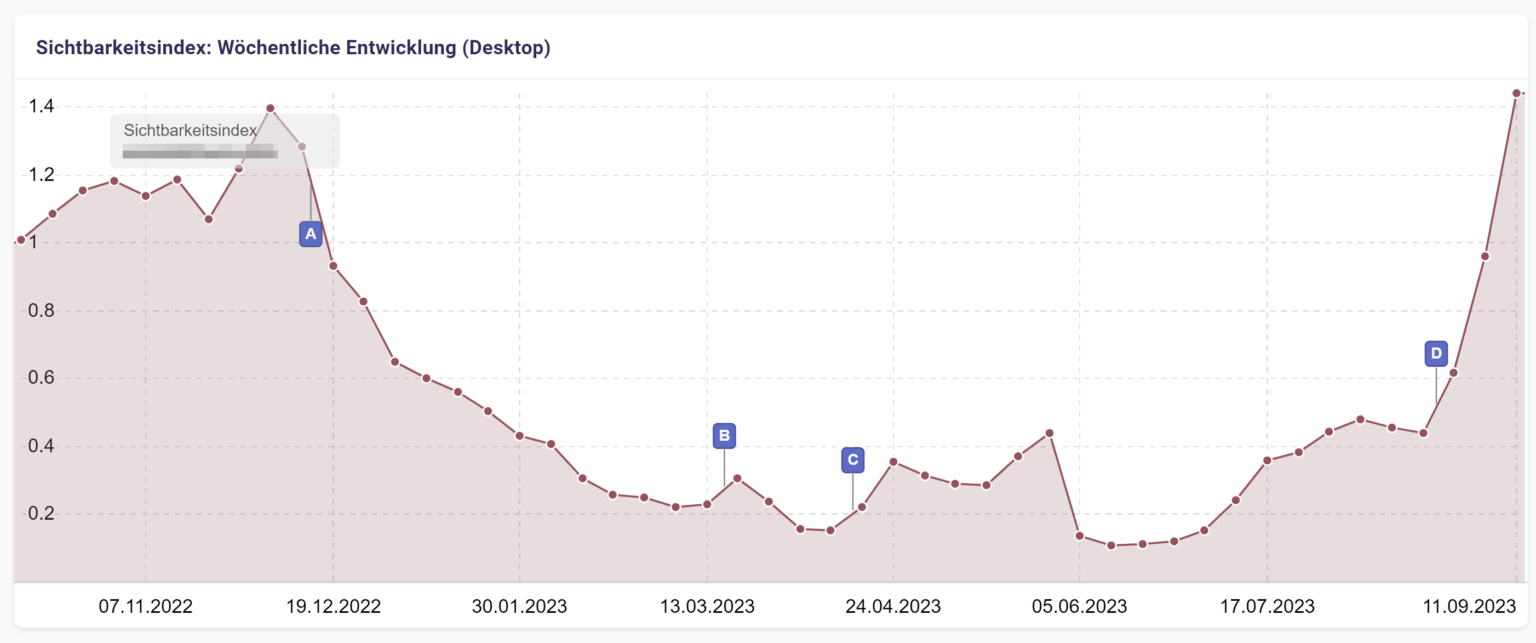
Stop a 75% loss in visibility within 6 months, identify the underlying issues, and implement a solution that enables the company to generate more revenue again. The link audit halted the downward trend and tripled visibility within 3 weeks, increasing it ninefold within 8 weeks (3 weeks = 300%, 8 weeks = 900%).
After 2.5 months, the best visibility in the past 2 years was achieved; visibility was restored to over 100%. During this process, harmful links were analyzed, and content spam was also reviewed and removed.