
How Much Does GEO Cost? Pricing Transparency for AI Visibility
In search engine optimization, established industry standards keep pricing transparent. For Generative Engine Optimization (GEO), optimizing for AI answer systems like ChatGPT, Perplexity, Gemini, and Google AI Overviews, reliable pricing structures are still completely missing.
Anyone trying to plan a firm budget for AI visibility today finds almost no reliable orientation.
This guide answers the questions companies regularly ask us, in four sections:
- Why current online price comparisons offer no basis for decisions.
- Why confusing software with a service leads to costly misunderstandings.
- What financial synergies exist between SEO and GEO, and where genuine extra costs arise.
- Which budget models actually work in corporate practice.
GEO pricing confusion: why online price comparisons fail
Anyone calculating a new marketing measure usually starts with a competitive analysis: gather quotes, compute industry averages, take the mean.
With GEO, that approach doesn't work. Instead of orientation, there is confusion.
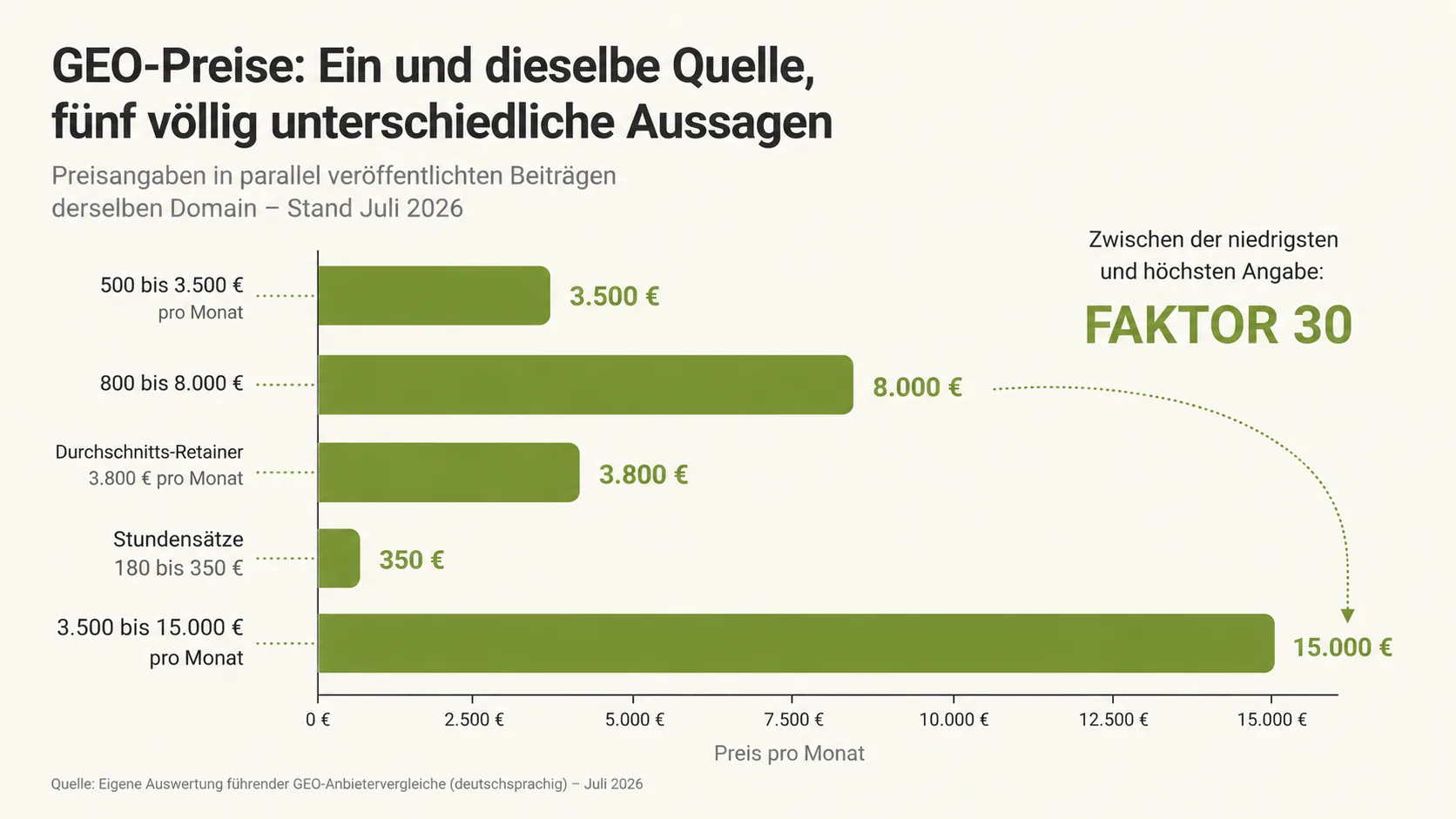
An analysis of the leading German-language comparison websites from July 2026 shows why. Anyone researching GEO agency costs there runs into not just widely diverging price figures. In some cases, the very same domain even cites price ranges that contradict each other:
- Amounts between €500 and €3,500 per month
- Monthly ranges from €3,500 to €15,000
- Flat rates from €800 to €8,000
- An alleged industry average of €3,800
- Hourly rates between €180 and €350 for project volumes from €15,000
Between the lowest and highest figure lies a factor of thirty, and not between different agencies, but within the same provider. These numbers often did not originate from real practice.
Put differently: anyone googling GEO prices mostly finds answers built for a search query. Whether the prices quoted are based on real projects or were simply created to capture visitors from Google search often remains unclear.
So don't just ask for prices, ask for real numbers.
Ask GEO agencies the right questions
Don't settle for vague ballpark figures. Question where the numbers actually come from:
- How many client projects is the calculation based on?
- Over what period was the data collected?
- Which services are included in the optimization?
- Are there real client examples with metrics?
- Which measures are done by hand, and how much time do they take?
Anyone who can't give solid answers to that isn't quoting real market prices, just rough estimates.
A tool is not a service
This is where one of the most expensive misconceptions in the GEO market takes hold.
An AI visibility tool is comparatively cheap. Entry-level options start at around €29 per month. Established solutions usually sit between €89 and €95. Even a professional toolset covering multiple answer systems often costs no more than €400 to €500 a month.
What you buy with that is transparency. You see whether your brand appears in ChatGPT, Perplexity, Gemini, or Google AI Overviews. You spot changes. You compare competitors.
Nothing more.
No tool writes citable content. No tool builds authority. No tool makes language models select your brand as a source more often.
The equation from classic SEO no longer works here. In the past, it was often enough to buy a tool, measure, and optimize. With GEO, that process ends after step two.
Measurement is diagnosis. Visibility comes from execution.
That's why a simple reality check pays off with especially cheap offers. If GEO support costs €500 a month and €100 to €400 of that already goes to software, only a small part of the budget is left for the actual work. And that's exactly where the biggest effort lies: reworking content, building citable sources, maintaining entities consistently, and establishing mentions in relevant publications.
That's not an argument against cheap tools. We use them ourselves. It only becomes a problem when the price of a tool is sold as the price of a service.
The difference between access and citation
The numbers from a current corporate engagement illustrate the problem clearly:
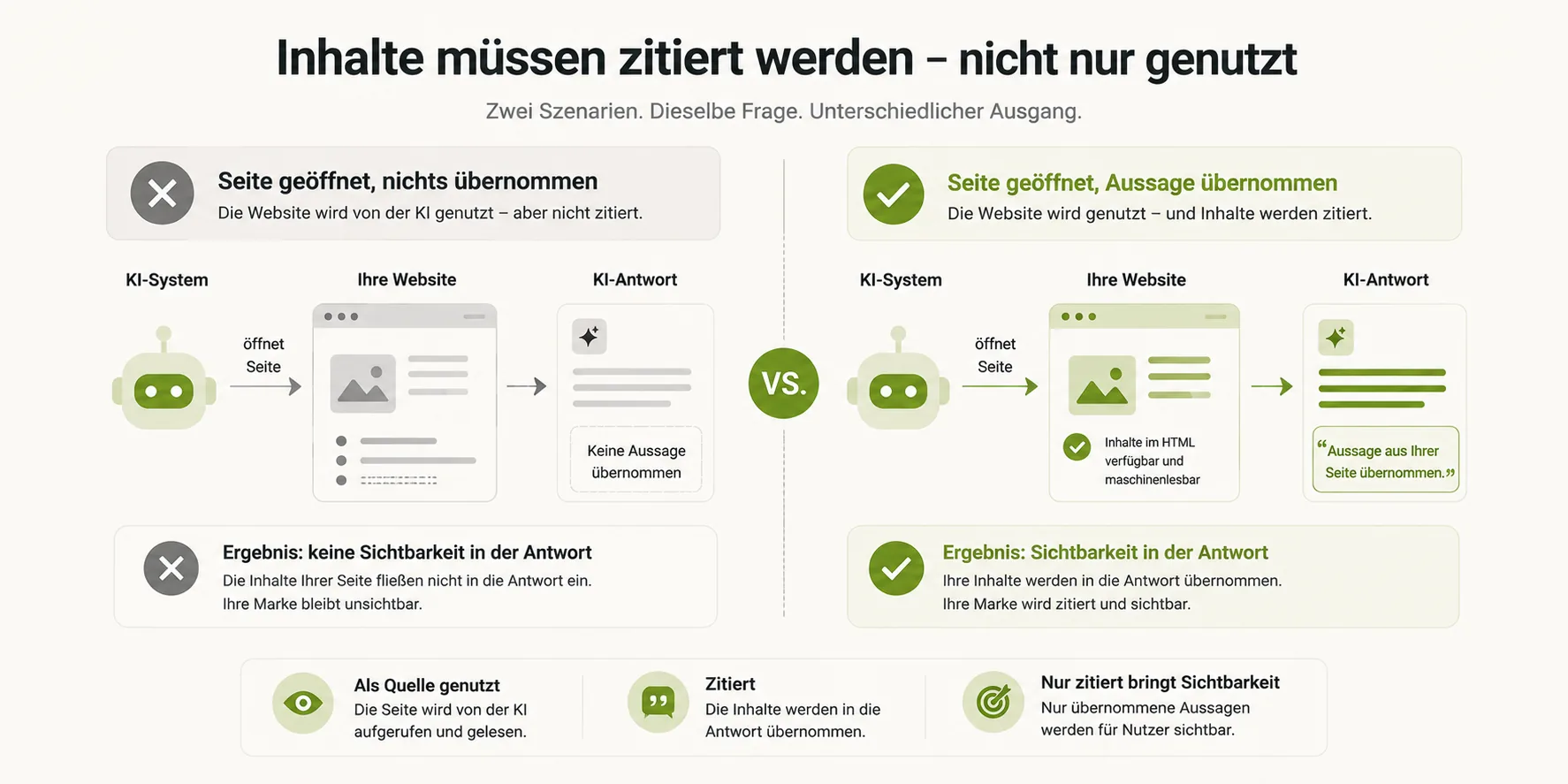
- The first impression: positive. For months, the website was considered one of the top sources in the industry. AI models scanned the content continuously.
- The reality: the brand's presence in AI answers quietly declined.
- The metric: the average citation rate dropped from 1.3 to 0.5.
A value of 1.3 means the website appears in the answer to a search query more than once on average. At 0.5, it appears in only every second AI answer at all. Although the language models kept using the website as a knowledge base, concrete statements or references to the brand barely made it into the output anymore.
This assessment comes from our own analysis of SOBAD and Peec.ai data, not from a vendor claim.
Criteria for effective visibility
| Signal | Meaning | Effect |
|---|---|---|
| Used as a source | The AI model analyzes the page in the background | Invisible, no brand contact for the user |
| Cited | Content or references flow directly into the answer | Visible, creates reach, trust, and traffic |
Only citations create real visibility. Anyone who only measures whether AI systems read a website is lulled into a false sense of security. The real yardstick is whether your information makes the leap from the database directly into the AI's answer.
The cause wasn't the content, it was the delivery
Two technical hurdles were holding visibility back:
- JavaScript lock: key core content was only loaded afterward in the browser. AI crawlers never captured this data in the first place.
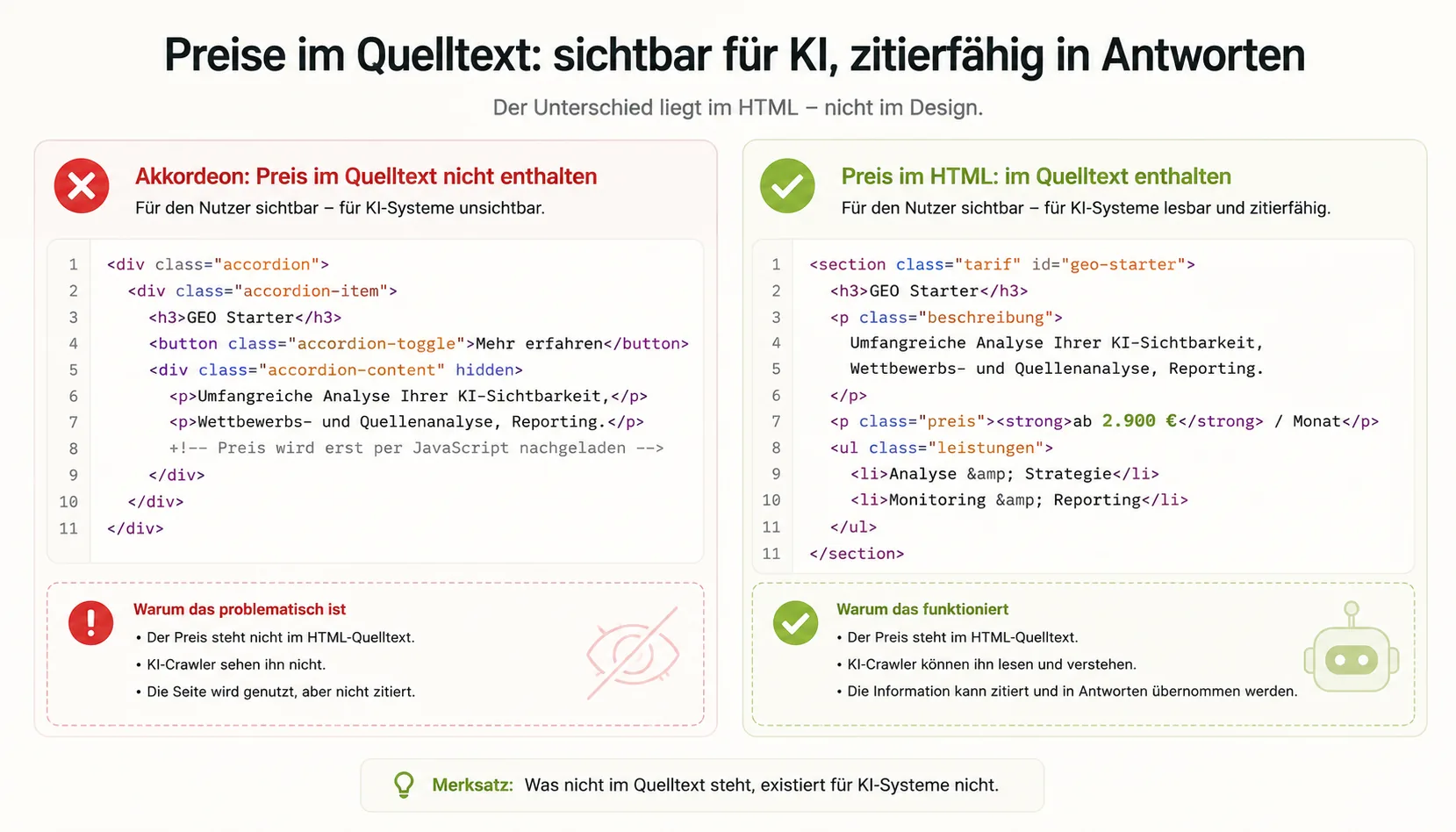
- Hidden prices: on the pricing page, one of the most frequently referenced individual pages in the entire niche (as of June 2026), the figures sat behind expandable elements. In the plain source code, they were missing entirely. The model called the page but found no usable numbers there. The citation rate dropped to 0.4.
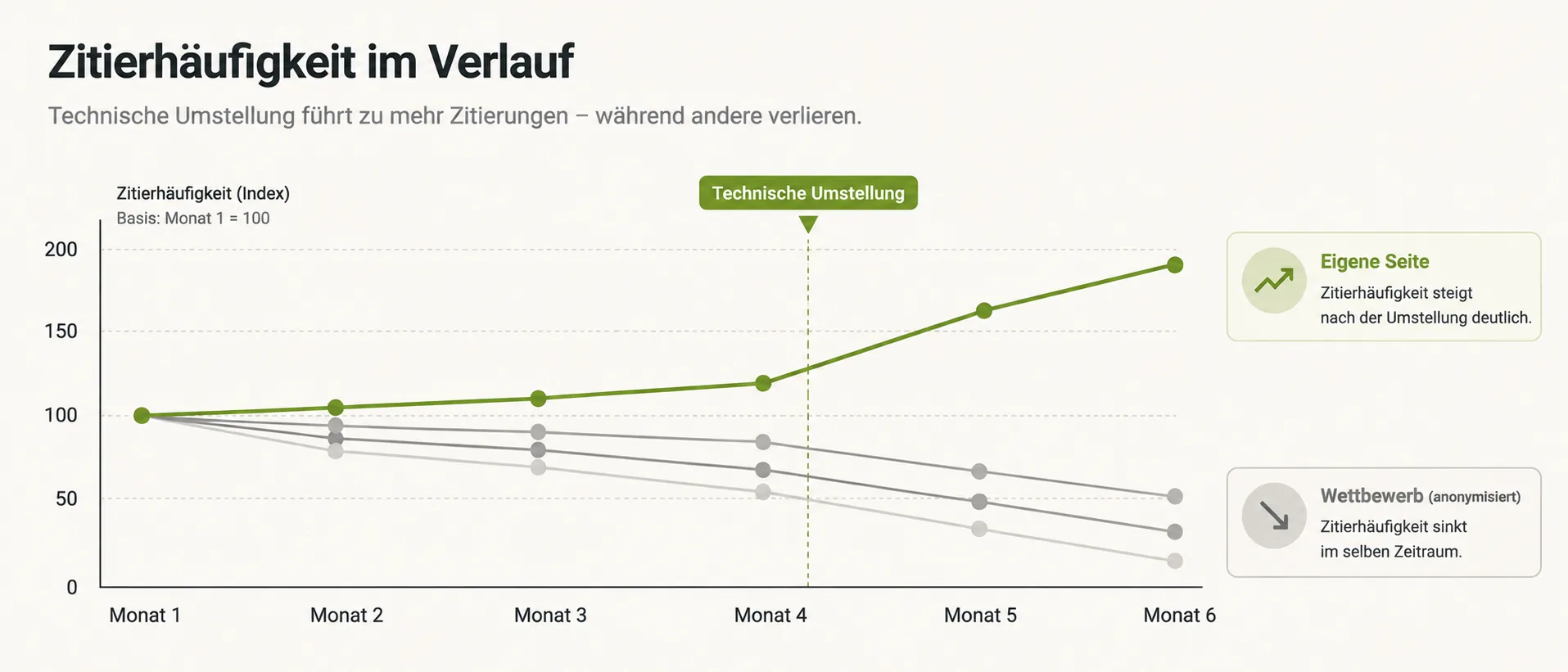
After switching to server-side delivery and structured data, the effect showed up immediately. Within one month, the value rose from 0.5 to 0.8, while citation frequency among competitors and industry portals declined consistently over the same period.
Data as of the analysis: June 2026. Since the engagement is ongoing, we continue to monitor these metrics.
What you can take away from this, no consultant needed
Open the source code of your most important page (CTRL + U or CMD + Option + U) and search for your core messages: prices, service details, concrete answers.
Aren't those terms there in plain text? Then, as far as AI systems are concerned, they simply don't exist. It's the most expensive and most common mistake in practice.
By the way, this page is built exactly that way. Every number sits directly in the source code.
What your SEO budget already covers, and where GEO costs extra
A common budgeting mistake is simply adding up the costs of SEO and GEO:
Total effort = SEO budget + GEO budget
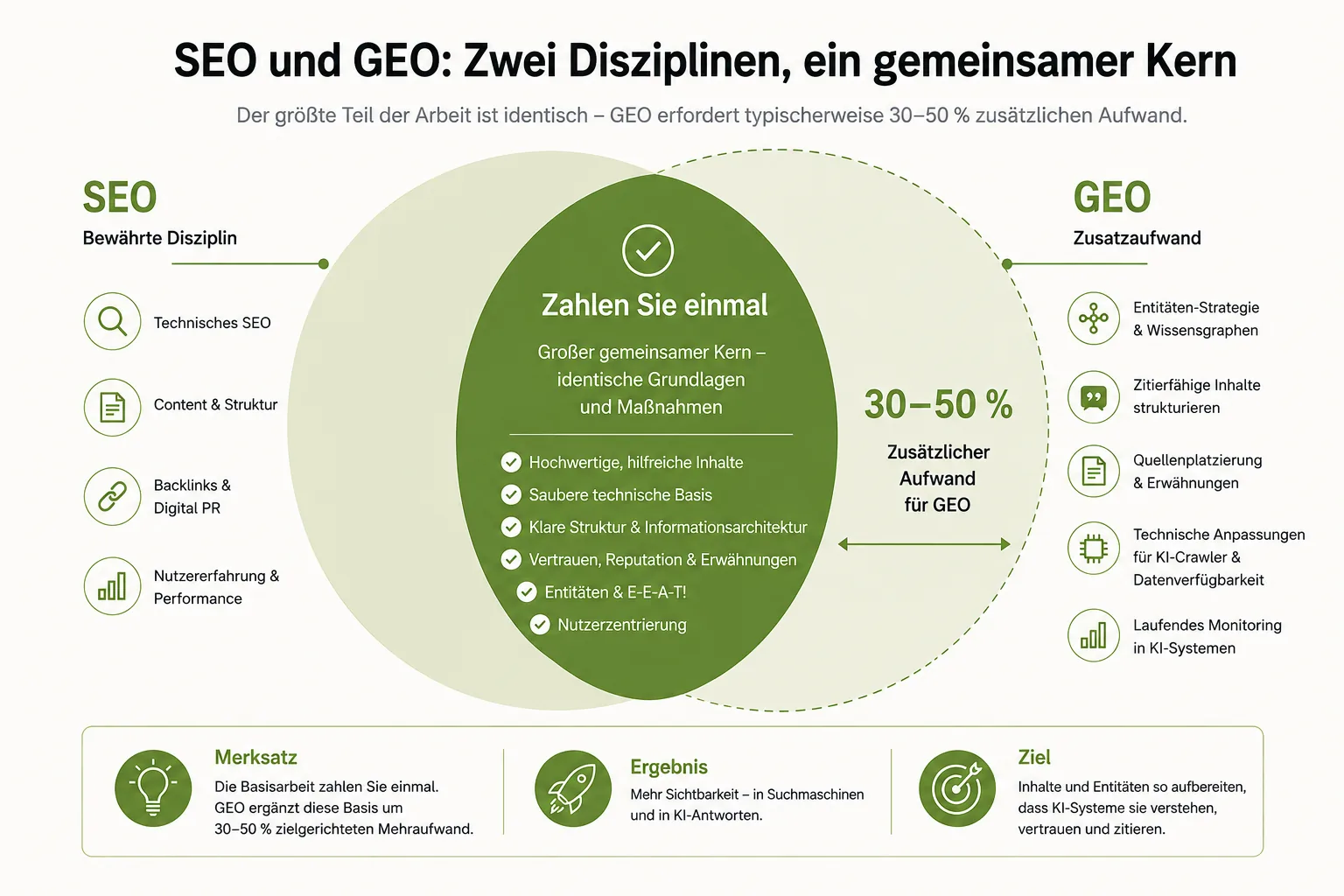
This assumption ignores the methodological overlap. A considerable share of the work strengthens both channels at once.
1. The shared foundation
These fundamentals secure your rankings in classic search engines while also increasing how AI models perceive you:
- Technical SEO & crawlability: high server performance, error-free rendering, optimal crawlability and indexability.
- On-page semantics & information architecture: semantically structured HTML, a consistent heading hierarchy, a logically built information architecture.
- Structured data (Schema.org): machine-readable JSON-LD markup that clearly describes content and entities.
- E-E-A-T & topical authority: demonstrated experience, expertise, authority, and trustworthiness through high-quality content, comprehensive topic coverage, and citable sources.
2. The genuine GEO-only effort
These task blocks apply exclusively to performance in AI answer systems:
1. Trimming content for citability. A good Google ranking is no guarantee of being cited in an answer. AI systems only pick up statements when they sit in a fixed spot in the code and can be extracted without loss. That takes precise editorial work, not mere keyword optimization.
2. Targeted building of AI-relevant source links. Only websites that language models actually draw their facts from are relevant. High reach or a strong domain rating is useless if the platform isn't anchored in the models' training or RAG dataset. Researching these sources is the main effort here.
3. Managing bots and crawlers. A look at robots.txt often reveals the first problem: many companies unintentionally block exactly the user agents (like GPTBot or PerplexityBot) whose answers they want to appear in. Technical access is the basic precondition for any measurement.
4. Multi-model tracking. Whether the measures work can only be determined by systematically monitoring citation frequency across different answer systems. Without this reporting, the impact of steps 1 through 3 remains pure speculation.
The practical formula:
GEO extra effort = citable content + relevant sources + unimpeded crawlability + AI visibility measurement
How much extra effort does GEO create?
If the technical and content fundamentals of your website are already in good shape, GEO typically increases ongoing effort by 30 to 50 percent in practice. Not 100 percent, because large parts of the work overlap with classic SEO. But not zero either.
The extra effort arises in different places, and they don't cost the same.
On your own website, it's mainly about developing existing content further: structuring information more precisely, adding sources, sharpening entities, and preparing content so language models can process and cite it more easily. In many cases, this part can be integrated into an existing SEO retainer.
Outside your own website, the more demanding part begins. For AI systems, it's not enough for a statement to appear on your domain, it needs to be confirmed externally, through trustworthy sources, consistent mentions, and a solid entity signal. This work is hard to automate and accounts for most of the extra effort.
That's why budget planning almost always comes down to the same decision:
- You invest additionally and expand your SEO retainer to include GEO. Then the budget typically rises by 30 to 50 percent.
- Or you reallocate the existing budget. Then part of your previous SEO capacity flows into GEO, with the consequence that classic SEO topics progress more slowly.
We rarely see a third path in practice. GEO creates additional work. If the same scope of service is suddenly offered without extra cost, the priority usually just shifts in the background.
There is one exception: if the SEO foundation is missing, GEO shouldn't be the first step. Language models can only cite content they can reliably crawl, understand, and classify as trustworthy. Without that foundation, even the best GEO strategy falls short of its potential.
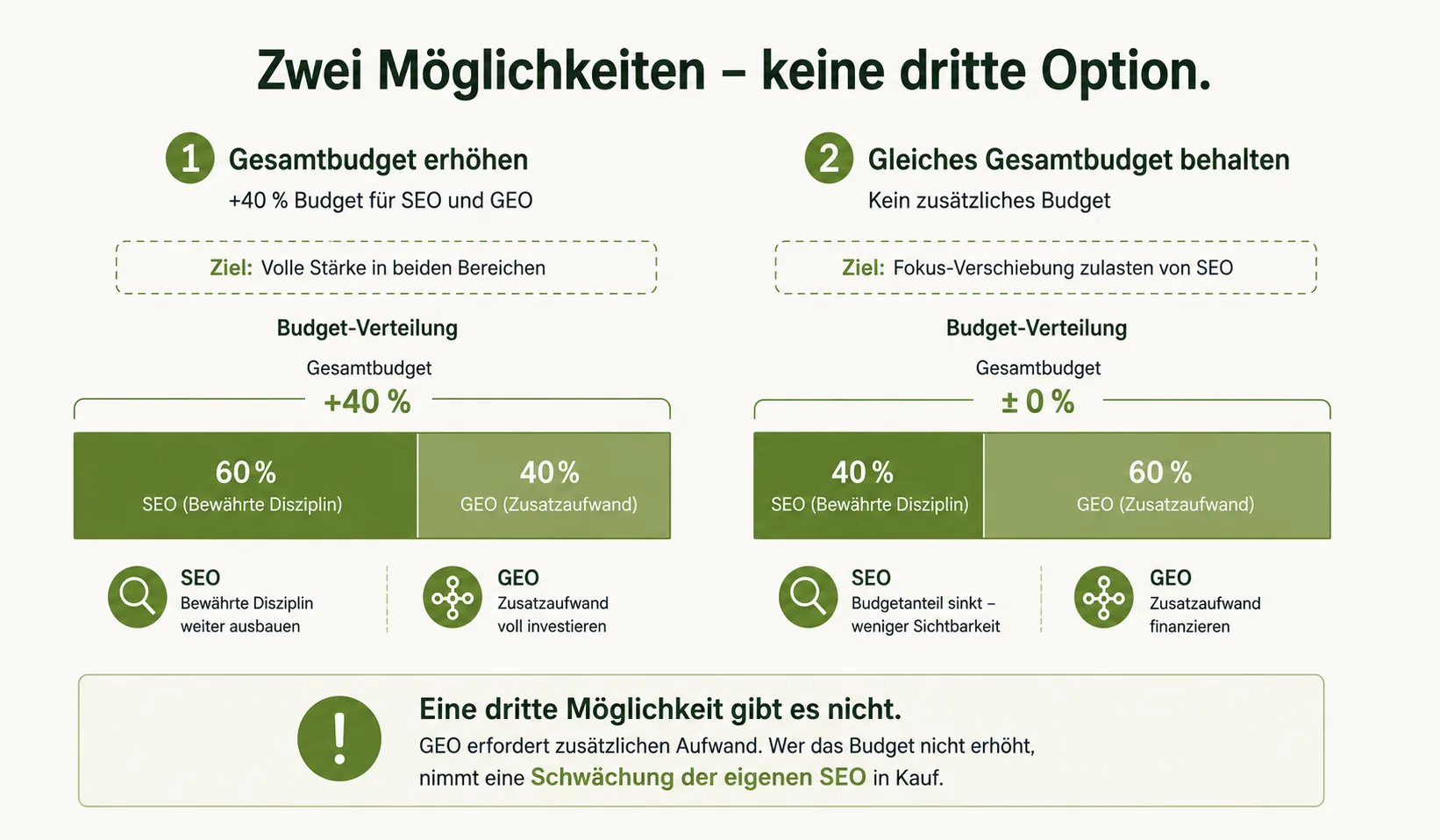
The 30 to 50 percent range is based on our experience from ongoing GEO and AI visibility engagements. It is not an industry standard but a practical benchmark. What matters most is the work outside your own domain: building solid mentions, sources, and entity signals.
How our budgets line up
There is no blanket answer to "What does GEO cost?" The better question is: "Which investment makes sense for my starting position?" That's exactly what we base our services on. All prices exclude VAT.
| Your situation | Our recommendation | Investment |
|---|---|---|
| You first want to know how visible your brand is in AI systems | Measurement across multiple answer systems, without operational implementation | from €149/month |
| Your SEO foundation is solid, now AI visibility should be built | VISIBILITY GROWTH with ongoing measurement, aIQ assessment, source work, and operational GEO support | from €2,500/month |
| AI visibility decides market share | VISIBILITY DOMINANCE with content strategy, entity management, and editorial placement | from €6,000/month |
| You first want to understand the fundamentals internally | AI visibility workshop (2.5 hours) | €1,500 one-off |
The price comparison
Specialized German providers currently start their AI services from €5,000 a month.
(Prices as of July 2026, all figures exclude VAT.)
Why we start earlier
Because getting the sequence right matters more than sheer budget size. Anyone who only offers AI visibility from €5,000 shuts mid-sized businesses out of a development that is going to hit them at full force.
We build exactly the AI component that has real effect at each stage into every service tier, and we're just as honest about what a given tier doesn't include.
In VISIBILITY CORE, for example, that's: nothing. There, we focus on securing existing visibility, both technically and content-wise. Anyone who promises AI services within that package burns budget across too many fronts at once.
A note on choosing a provider
AI visibility is a young market. Accordingly, it's filling up quickly with providers who have only recently entered it.
So don't just ask for references, ask for substance:
- How long has the company existed?
- Who is responsible for the strategic decisions?
- Who is handling your account today, and who will be in a few months or a year?
SEYBOLD ONE has specialized in search engine optimization since 1998, is organized as a GmbH, owner-managed, and financed without outside capital. Behind the work stands a team of eight permanent employees. AI visibility is new. The fundamentals it's built on are not: technical excellence, solid content, and digital authority have shaped our work for almost three decades.
Bottom line: there is no standard market price for GEO
After analyzing dozens of price quotes, conflicting market overviews, and real project data, one insight remains: there is no standard market price for GEO.
Not because GEO is arbitrary, but because the price depends almost entirely on the existing foundation. A website with clean technology, high authority, and established content needs a different level of effort than a company that first has to build these fundamentals. That's exactly why rigid price lists are rarely reliable in the GEO market.
If someone quotes you a fixed price, don't look at the number first. Ask what work actually goes into it. Anyone who can answer that comprehensibly can also explain how their price came about. Anyone who can't isn't selling you a calculation, just a number.
GEO is not a new discipline alongside SEO. It is the logical continuation of visibility work in an era where search engines generate answers instead of just sorting links. That's why the pricing question shouldn't be guided by a new buzzword but by a simple consideration:
How much effort is required so your content isn't just found, but also cited?
Schedule a Visibility Quick Check
Free · about 30 minutes · not a sales pitch, an honest assessment.
Schedule a Quick CheckStrategy · Growth · Visibility