
Global SEO Strategy: Breaking Barriers for International Expansion
International SEO and hreflang implementation require a lot of preparation because expanding a national domain strategy into an international one presents many pitfalls. It's not simply a matter of offering one's services to foreign countries. Rather, rankings in the respective target countries should occur with the right websites. And of course, the settings for language and currency on one's own site should also be consistent.
A strategy for international SEO requires solid planning.
These planning steps help you not to get bogged down. When planning for international content, there are the following stumbling blocks:
- Prioritizing international target markets
- Which countries or languages should be targeted?
- Do I have enough resources to populate content for these countries?
- Should the countries or languages be provided?
- Domain strategy
- What should the strategy look like to play the target country/target language ideally and with the least effort? (Different top-level domains, subdomains, or folder strategy?)
- Keyword strategy and content prioritization
- What content interests the users?
- Are there differences in search behavior in the respective country or language?
- hreflang: Correct addressing of the content
- on web pages
- in sitemap
Prioritizing international target markets
When prioritizing target markets for an international audience, we need to know which countries and languages could already show increased interest in the company. So, the first question is, in which countries should the content be additionally presented? A look into Google Analytics helps with that.
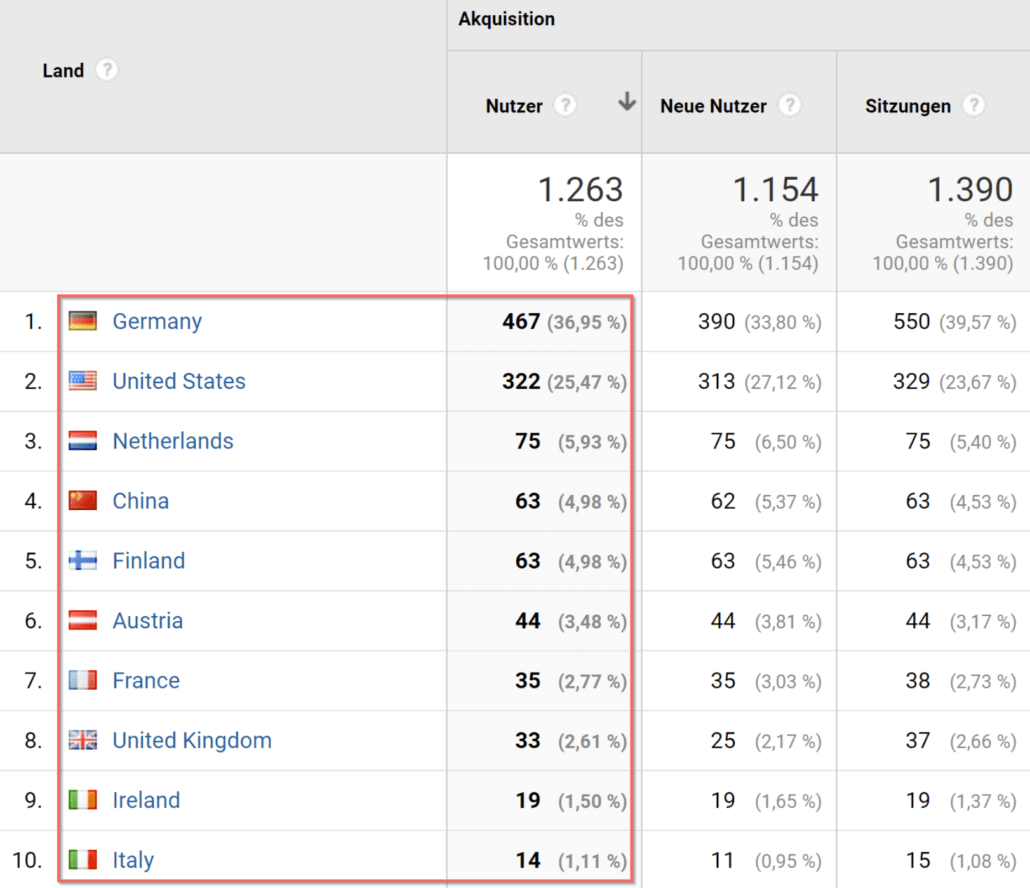
Über den Zielgruppenbericht (Zielgruppe -> Geografie -> Standort) kann herausgefunden werden, von welchen Standorten auf die Website zugegriffen wird.
Welche Sprache die Besucher in ihren Webbrowsern verwenden, kann man auch über den Zielgruppenbericht (Zielgruppe -> Geografie -> Sprache) in Erfahrung bringen.
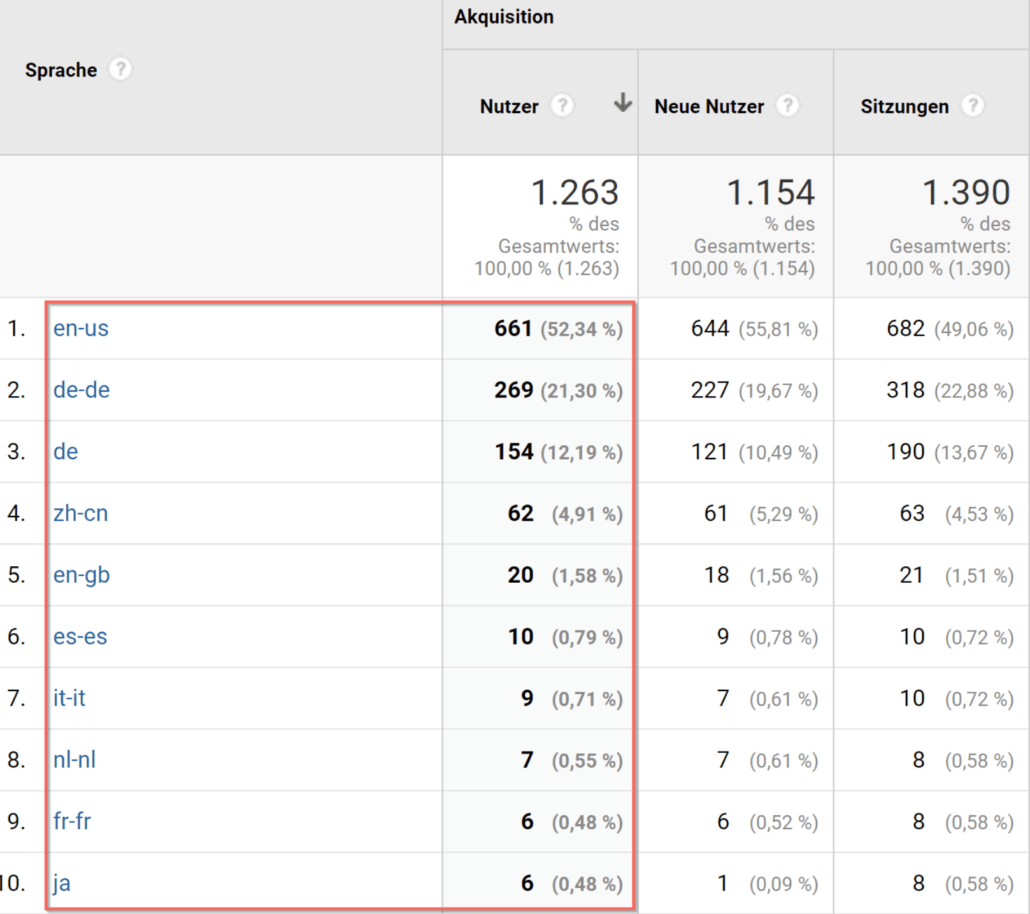
The example shows where the target markets are located and with which languages the company should operate. Important language variants in this case would be English, German, and Chinese. Possible future languages could include Spanish, Italian, Dutch, and French.
The wrong approach would be to offer all languages immediately. The biggest problems at this point arise from the fact that the resources for translating (or generating new) content are not sufficiently available.
While English and German are usually still relatively easy to represent, it often becomes more difficult for us Europeans when it comes to Chinese, Arabic, or Russian content. The obstacles here are not only the lack of language habits but also the different characters (and reading direction).
So, what's important is: What "other" languages are spoken in these countries? Can you find a common denominator? Which education levels am I targeting with my content? Can one expect that people in that country are proficient in German or English? Based on these languages, you should decide on the primary languages to use. And then all relevant content must be provided for these languages. This requires resources (translators, web administrators…).
Additionally, it's essential to consider the search volume for the most important terms, as these can also influence the strategic considerations for expanding business fields.
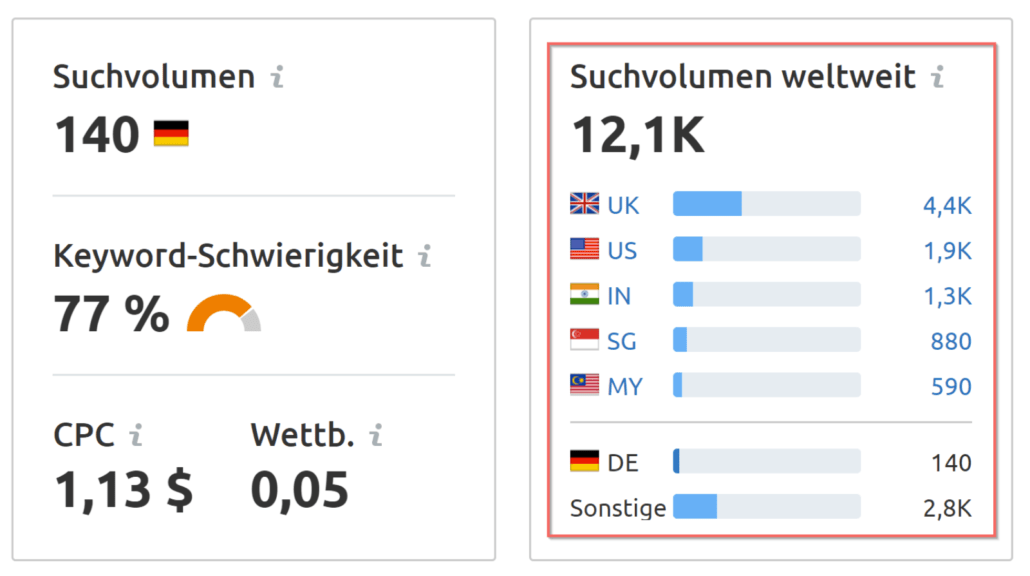
Additional languages can be added when requests from the respective countries increase and when the resources are available to deliver this content.
Should the offerings be presented per COUNTRY or per LANGUAGE?
Here we definitely need information from search engines because the following points are crucial:
- Is the country crucial for your business? Do you have a branch there or is one planned? Are there special customers you serve there?
- Is there enough search volume and traffic in these countries?
If there are enough potential conversions in a country, then the country strategy should be pursued. If search volume and traffic are more language-dependent, then a language strategy is better.
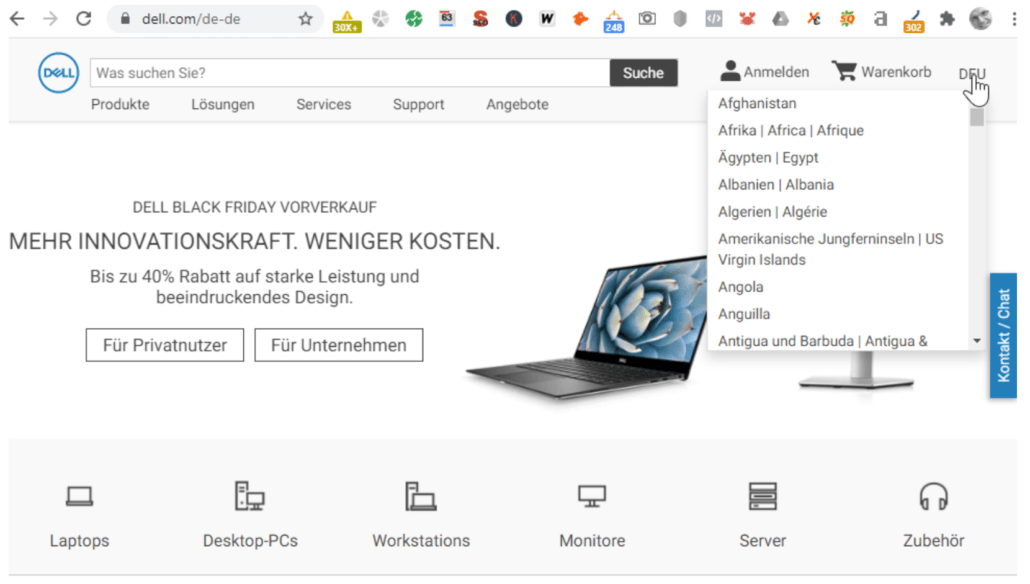
Example: Country Strategy at DELL
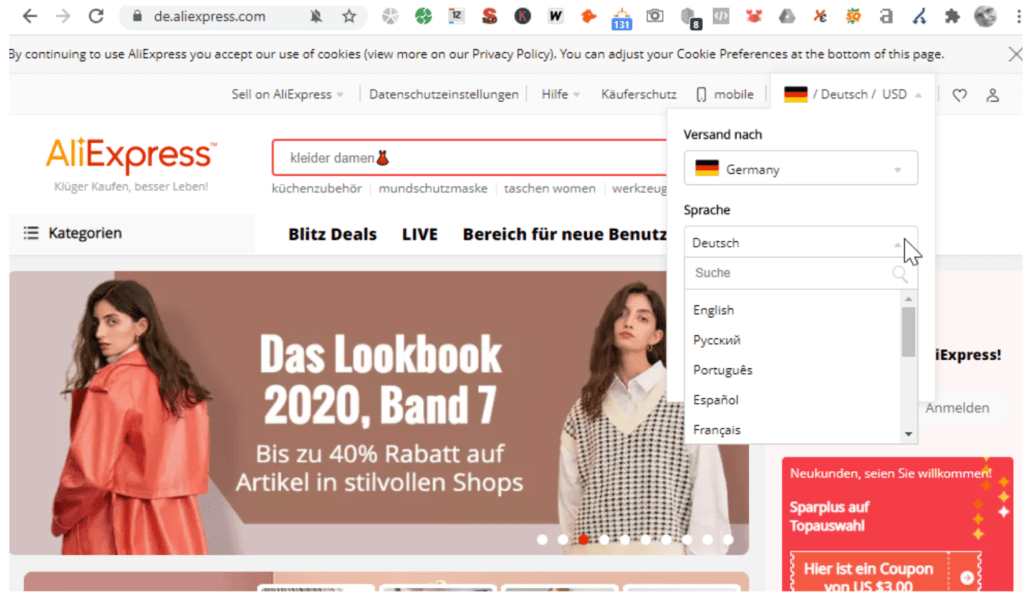
Example: Language Strategy at AliExpress
Whether an investment in the respective country is worthwhile in anticipation of the visitors to be received can be determined with an ROI calculator: https://www.aleydasolis.com/english/international-seo-tools/roi-calculator/https://tools.totaleconomicimpact.com/go/conductor/seo/
Domain Strategy: How to Present International Content?
In the context of internationalization, we are often faced with the question of how to serve the respective countries. So, what is the ideal strategy to play the respective target country or language with the least effort and the highest chances of success for ranking?
Should different top-level domains (ccTLDs) be used? Is a subdomain strategy the right choice? Or do we use subdirectories?
Common mistakes in domain strategy:
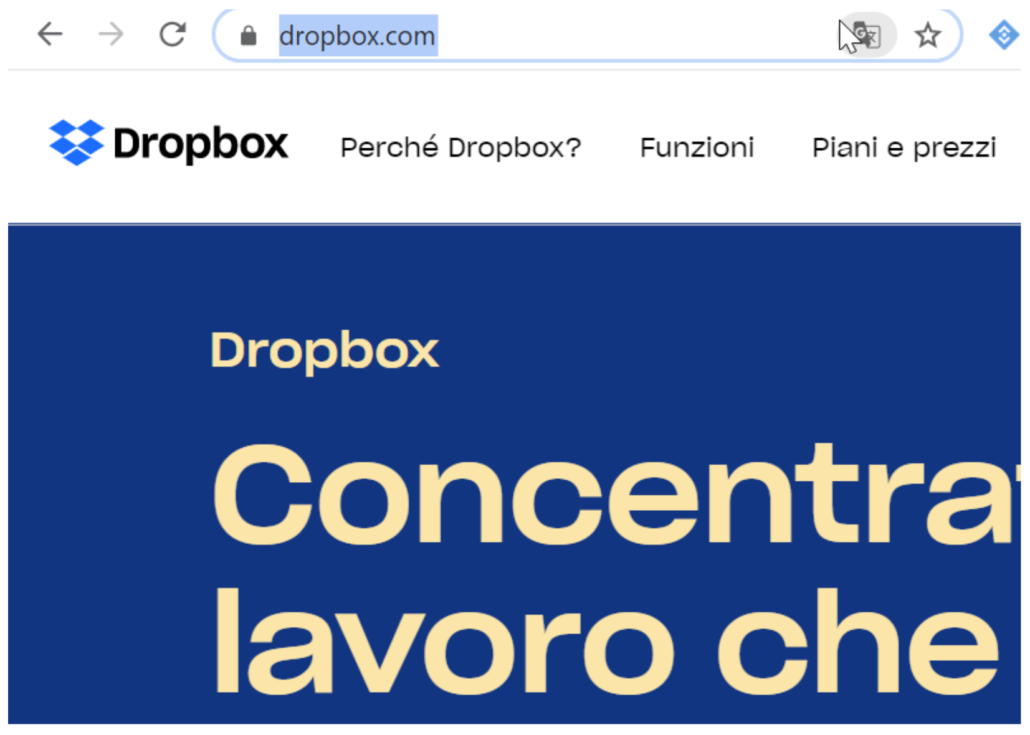
- Using scripts or cookies to display a page without changing the URL (automatic detection of browser language/geolocation and storing in cookies).
Example: Dropbox -> Language switch and storage in cookies
2. Never use a parameter as a switch for international presentation:
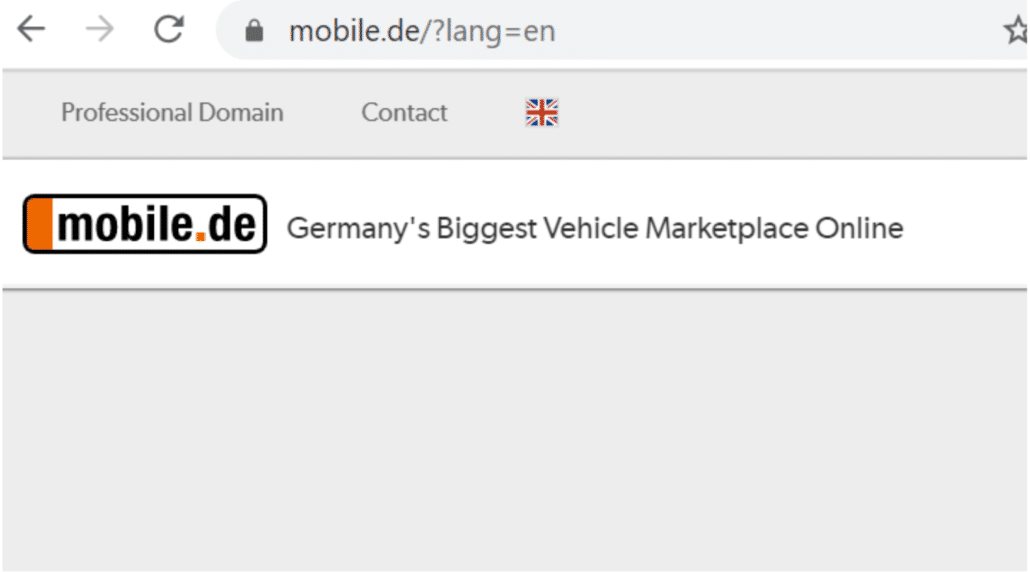
Beispiel: Language switch by parameter at mobile.de
- Folder structures or subdomains cannot be used to link to other target country domains.
- Google does not support regions (regional top-level domains, such as .eu or .asia, are not associated with geographical regions).
Domain Strategy for Target: Countries
If individual countries are to be included in the strategy, the following options are available:
Country Domain (ccTLDs): www.name.de, www.name.de/product-category-1/
Advantages and Disadvantages:
- Ideal solution if the competition is manageable.
- Requires many technical resources.
- Requires backlinks/popularity (especially for new domains).
Folder Structure: www.name.com/de-de/, www.name.com/de-de/product-category-1/
Advantages and Disadvantages:
- Requires fewer technical resources.
- Less effort in link building (because existing popularity can be used or lower effort for new links).
- Higher risk if there is a penalty against the domain.
- Higher requirements for geolocation (routing the correct country to the appropriate language).
Subdomain Structure: de-de.name.com, de-de.name.com/product-category-1/
Advantages and Disadvantages:
- Requires more technical resources.
- Requires more effort for link building, as a subdomain is seen as a "new" domain.
- Clearer for very complex and large websites than the folder structure.
- Higher requirements for geolocation (routing the correct country to the appropriate language).
Domain Strategy for Target: Languages
If different languages are to be targeted, the following options are usually available:
Folder Structure: www.name.com/de/, www.name.com/de/product-category-1/
Advantages and Disadvantages:
- Requires few technical resources.
- Less effort in link building (because existing popularity can be used or lower effort for new links).
- Generates a deeper URL structure.
- Higher risk if there is a penalty against the domain, as then all languages are affected.
Subdomain Structure: de.name.com, de.name.com/product-category-1/
Advantages and Disadvantages:
- Requires more technical resources.
- Requires more effort for link building, as a subdomain is seen as a "new" domain.
- Large websites benefit from the shorter URL.
- Depth of structure (product categories are "higher up" in the hierarchy).
It is useful to consider how the competition has made their structural choice.
Examples:
- Tripadvisor uses country domains (tripadvisor.fr, tripadvisor.de, etc.).
- Hotels.com uses subdomains for languages (fr.hotels.com, de.hotels.com, etc.).
- Trivago uses country domains (trivago.es, trivago.de, etc.).
- Expedia uses country domains (expedia.es, expedia.fr, etc.).
- Booking.com uses folder/HTML structures (index.es.html, index.de.html, etc.).
Which is the right decision for my business?
Target Country Strategy:
- Do competitors use top-level domains (ccTLDs)?
- Yes: then choose a top-level domain, unless the domain authority value of your domain is higher than that of the competitors.
- No: Use a folder structure (de-DE, en-GB, etc.).
Target Language Strategy:
- Is the scope very large and you need a flatter structure?
- Yes: then use subdomains if the domain authority (DA) of your website is smaller than the DA value of the competitors.
- No: If your domain is stronger or you don't need a flat structure, use the folder structure (/de or /en, etc.).
How does Google determine the target country?
Google has several ways to determine the target country.
- If a geographical orientation is desired, this can be specified in the International Targeting report of Search Console. The Search Console specifies which country the website should be associated with.
- Country Code Top-Level Domain Names (ccTLDs) are tied to specific countries. For example, ".de" stands for Germany or ".cn" for China. Both users and search engines use these domains to determine which country the website is intended for. In some countries, the use of ccTLDs is reserved for specific groups of people. This also applies to some generic top-level domains (gTLDs), such as ".tv" or ".me."
- hreflang attributes in tags, headers, or sitemaps.
- Server location (via the server's IP address)
- Local address and phone numbers
- Use of local language and currencies
- Links from regional websites
- Use of Google My Business
What Google definitely does not do is use different crawlers on a website to find possible variations. Google also ignores GEO tags (GEO Standard Meta Tags), such as geo.position or distribution or HTML. Google also recommends allowing users to choose the appropriate version through a language switcher. An automatic GEO IP redirect may cause certain content to be withheld from users (including Google crawlers). Therefore, this type of language redirection is not suitable or recommended.
Keyword Strategy and Content Prioritization
For content on international sites, it is absolutely essential that you use local habits. Translations should generally be created by native speakers, and translations should then also use appropriate words.
Example: Proverbs
- Talk around the bush = To beat around the bush
- as cool as a cucumber = to stay calm
- Non tutte le ciambelle escono col buco = Not everything goes as planned
But also the use of certain, locally used terms can be problematic.
Elevator shoes = Shoes that make you taller (thus pretending to be taller). But in no case elevator shoes.
Such peculiarities should be clarified within the team in good time, and the translators should receive an appropriate briefing.
Prioritizing content is also important. Content that is very frequently read in the primary language may also be of high interest in translation. Exception: The content relates specifically to a particular topic that applies only to the respective country.
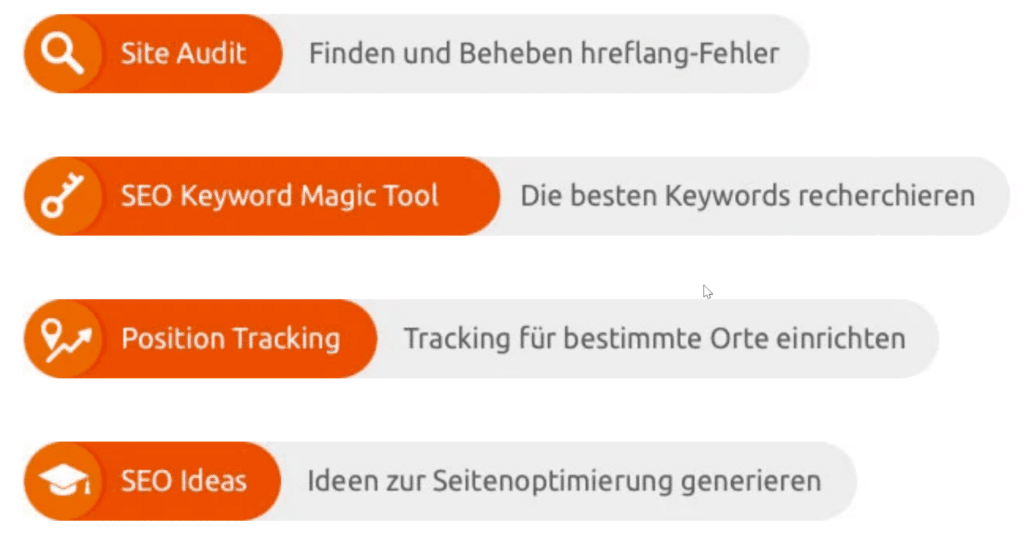
A good tool that you can use to check hreflang implementation, research keywords, check local positions, and find new content ideas is SEMrush. You can enter your domain for a free site analysis here.
hreflang: Correct Addressing of Content
hreflang helps to correctly address pages.
What is hreflang?
Hreflang attributes are tags that inform Google which language and alternative country-specific orientation each page should use. These are specified on pages. When many different language or country versions are used on a page, the hreflang tag should indicate the correct one for each.
Hreflang Tag Values Taxonomy
Hreflang tags make it easier for Google to select the correct page to display in search results in different languages and countries, and to understand that while there may be different URLs with very similar content, they are not duplicates because they target different audiences in different countries speaking the same language. A website should have its corresponding HTML instructions for languages. First, the language of the content should be specified.
Content Language Tag
The Content Language Tag is the correct approach for this.

As a next step, the hreflang languages need to be defined.
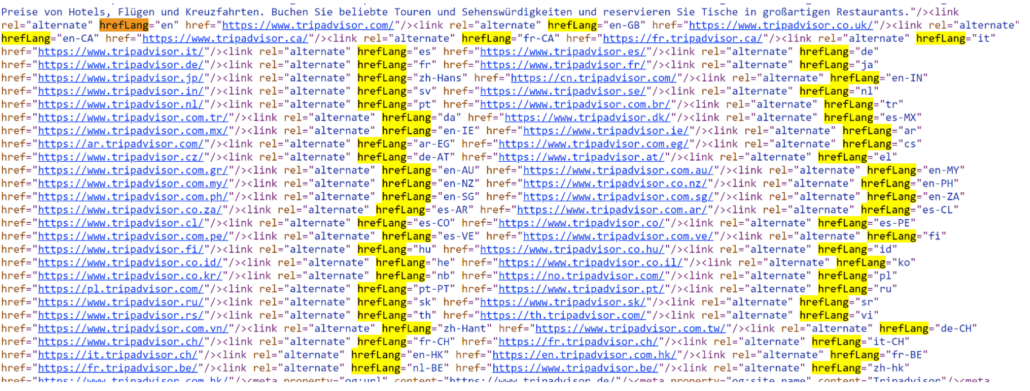
How is hreflang implemented?
The implementation of hreflang on a page can look like the example shown here:
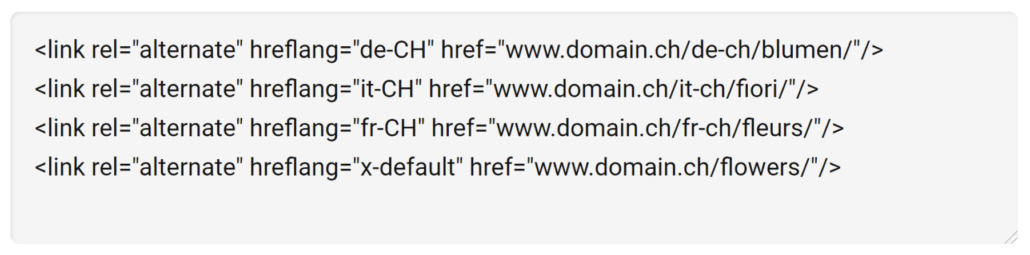
If you target different languages within one country, then hreflang tags must be included in the document. Each page must link to its corresponding counterpart in another language or location. Also, remember to consider the canonical tag.
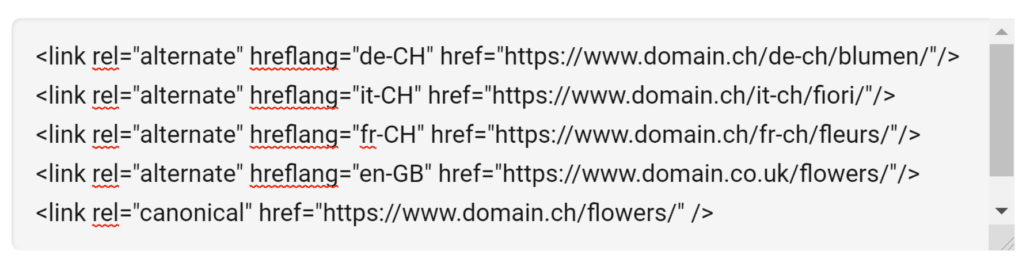
If there is a language that should be defined as the default or fallback language, it can be marked with the x-default tag.

How is hreflang structured?
Breaking down the code in the example above reveals the structure of hreflang. This HTML command is constructed as follows:
- <link …. /> opens or closes the command.
- rel="alternate" indicates that the following page is an alternative to the current page.
- hreflang="xx-xx" specifies the language and country variant of the page.
- it as the first definition represents the language in the form of an ISO 639-1 code.
- CH as the second definition represents the country in the form of an ISO 3161-1 Alpha 2 code. This is used when the language applies to a specific country. Examples include de (German) for DE, AT, CH (Germany, Austria, Switzerland), or fr for France, Switzerland, Canada (FR, CH, CA).
- href="https://www.domain.ch/it-ch/fiori/" specifies the corresponding target for the specified language/country selection.
What is x-default?
The "x-default" tag serves as a fallback variant that is used when no suitable language or country setting is available in the browser. In this case, the page specified as the URL will be displayed.
Can hreflang be used together with a canonical?
A canonical can be used as long as it refers to itself. If the canonical refers to another page that does not have hreflang attribution, its usage is incorrect. Only URLs that exist in different language variations are included in the Google index and receive hreflang attributes.
What are common errors in hreflang definition?
Incorrect ISO codes are commonly used, such as "en-UK" for English in the United Kingdom. The correct code is "en-GB". Careful attention and vigilance are required in such cases. "be" does not represent Belgian French but rather the language spoken in Belarus. Correct usage would be "fr-be" for French in Belgium or "nl-be" for Dutch in Belgium. Various generators are available to facilitate correct hreflang implementation. Some of these generators can be found here:
- https://www.aleydasolis.com/english/international-seo-tools/hreflang-tags-generator/
- https://moz.com/blog/using-the-correct-hreflang-tag-a-new-generator-tool
- https://app.sistrix.com/de/hreflang-generator
Tools for hreflang validation
Before publication, it is essential to validate the implementation of hreflang. This can be done using tools such as SEMrush, Ahrefs, Deepcrawl, Sitebulb, Screaming Frog, Ryte, or Sistrix, alternatively with the hreflang Checker. Additionally, the Chrome plugin hreflang Tag Checker can be helpful.
WordPress and hreflang – Which plugins are recommended?
WordPress can offer the necessary language tags using plugins such as WPML or Polylang, or with Plugin HREFLANG Tag Lite. Implementing hreflang in a WordPress site is easily achievable with these plugins. For WordPress Multisites, there is the Multisite-Language-Switcher plugin. These plugins provide excellent support for implementation.
Are there hreflang plugins for e-commerce platforms?
For e-commerce platforms, the following plugins are available:
- Magento: Mageworx Magenot 2 SEO extension
- Shopify: Weglot
- WooCommerce: WPML
- Shopware: hreflang-Management or hreflang advanced
Sitemap.XML – hreflang in the sitemap
If the hreflang tag cannot be integrated into the HTML code, it is advisable to include it in the sitemap submitted to Google. It is essential to ensure correct encoding. Ideally, both methods should be used to provide Google with as much information as possible about your internationalization strategy.
In general, there are two approaches to using hreflang in sitemaps: language-specific separation of sitemaps (each country/language has its own sitemap) or using a single sitemap.xml file for all languages. The sitemap.xml should be structured approximately as follows:
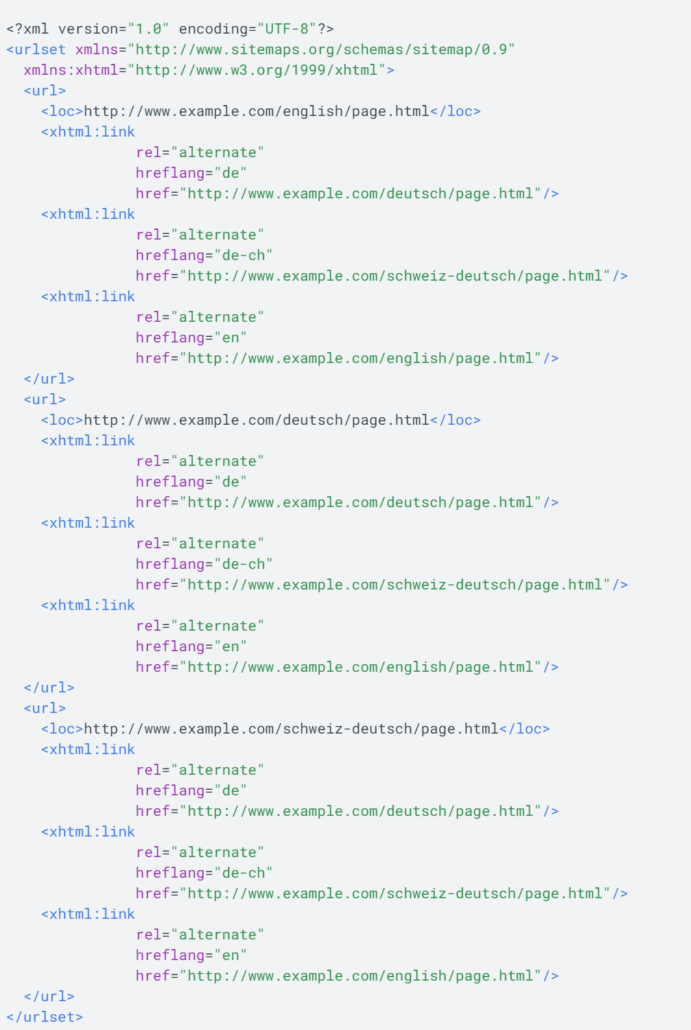
An x-default value can be used. It's important to note:
- Each language version must list itself as well as ALL other language versions.
- Alternative URLs must be fully qualified (i.e., with https:// and not in a shortened format).
- Alternative URLs do not necessarily have to be in the same domain.
- If two pages do not reference each other, the page will be ignored!
- X-Default can be used as a catch-all page for all languages not defined.
It's important to decide on at least one variant, but it's better to implement both variants. This was recently confirmed by Google in its SEO Office Hours (John Müller on hreflang HTML vs. Sitemap: https://www.youtube.com/watch?v=i_5ap7c0ynA&t=9m15s).
Conclusion: Good planning necessary due to many pitfalls
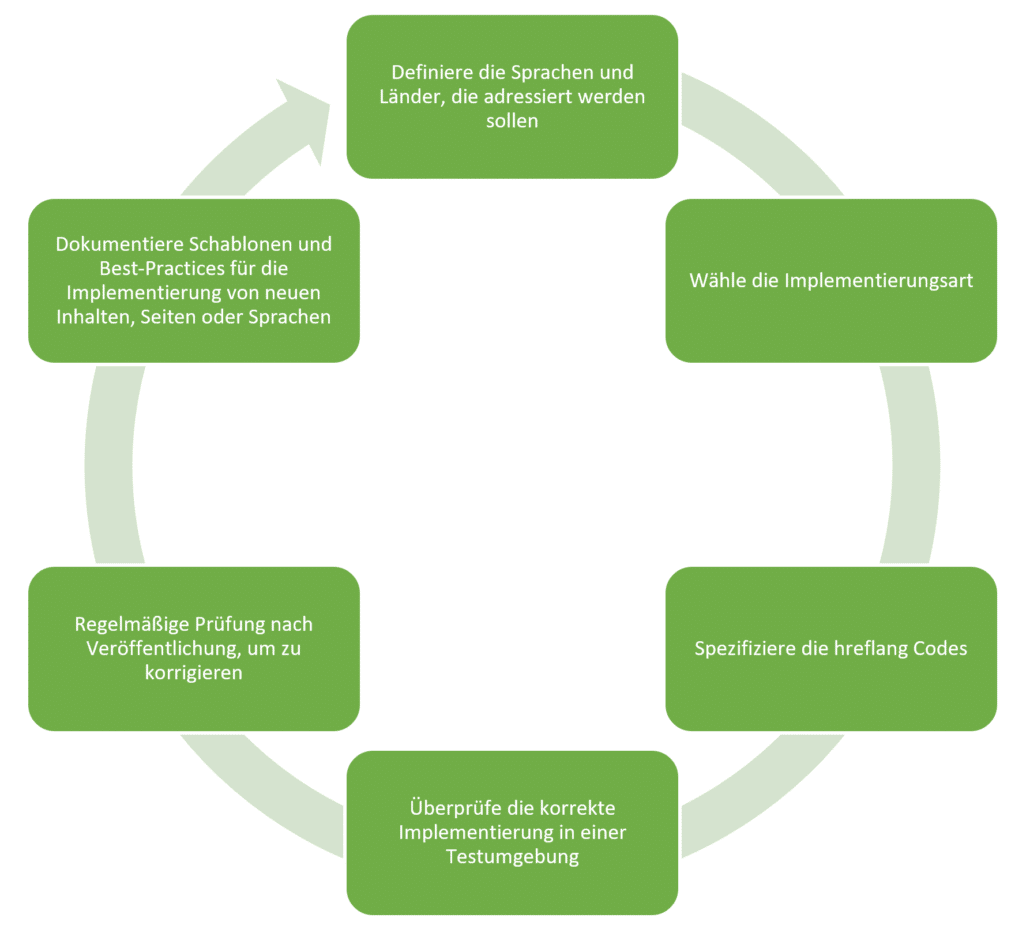
Implementing multilingual content for the appropriate countries is not easy. There are many possible errors, and in the worst case, important pages may be excluded from the Google index. The process diagram below can be helpful in implementing hreflang.
Source: Aleyda Solis
Additional sources and further reading pleasure:
https://developers.google.com/search/docs/advanced/crawling/managing-multi-regional-sites?hl=de&visit_id=637412455891972191-1299894649&rd=1
https://developers.google.com/search/docs/advanced/crawling/localized-versions?hl=de&visit_id=637412970168843572-3319617064&rd=2
https://www.aleydasolis.com/english/international-seo-tools/hreflang-tags-generator/
https://de.semrush.com/blog/international-seo-strategie/
https://ahrefs.com/blog/de/hreflang-tags/
https://moz.com/learn/seo/hreflang-tag
https://www.sistrix.de/hreflang-guide/